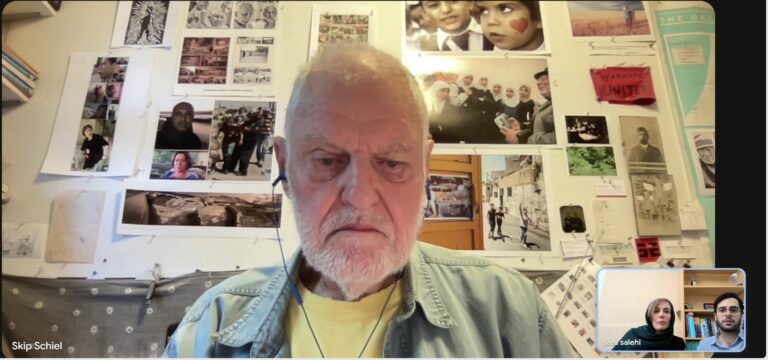
In continuation of the Organization for Defending Victims of Violence’s (ODVV) efforts to document the gross violations of human rights and international humanitarian law resulting from the recent military aggressions by the United States and the Israeli regime against the Islamic Republic of Iran, and in order to foster human rights discourse and develop specialized literature through dialogue with prominent international experts, the organization conducted an exclusive interview with Skip Schiel.
Skip Schiel is an American photographer, filmmaker, writer, and social justice activist based in Cambridge, Massachusetts, who since 2003 has dedicated a major part of his professional work to reflecting the human rights situation in Palestine and Israel, with a special focus on the daily lives of Palestinian civilians. By conducting multiple field trips to Gaza, the West Bank, and the occupied territories, he has captured through his camera lens the life challenges of communities affected by conflicts, displacement, and movement restrictions. His last presence in Gaza dates back to 2013, and since then, due to the imposition of severe restrictions, he has not been able to gain access again.
In prominent documentary projects such as The Ongoing Nakba and Eyewitness Gaza, Schiel has depicted various dimensions of the lives of internally displaced persons, the consequences of home demolitions, and the realities of life under occupation and siege. Having a background in teaching and volunteer photography for the American Friends Service Committee (AFSC) and receiving the “Inspiration for Hope” award, he has consistently strived to make the bitter experiences of affected civilians tangible and understandable for audiences outside the conflict zone by combining visual documentation, eyewitness testimonies, and peace activism.
Below, the most important aspects of his views and observations in the dialogue with the Organization for Defending Victims of Violence are presented:
Eyewitness Accounts from Gaza; Firsthand Observations of Gaza; People’s Suffering and Resistance
Skip’s field experiences in Gaza unveil profound tragedies. In his professional approach, he focuses directly on the faces of victims to portray the humanity that fades in the shadow of war. He points to a photograph he took in 2004 of a Palestinian girl; a girl who was targeted by an Israeli sniper while playing in front of her home. In his belief, and quoting the attending doctors, although the physical wounds of such attacks can be treated, the psychological trauma of war is very difficult to heal. Recalling his photography of the survivors of “Operation Cast Lead” in 2008, he also documented the living conditions of people in tents at that time and sorrowfully emphasizes that the current catastrophic situation of civilians in Gaza is even worse than those dark days.
The Price of Telling the Truth: Blind Resistance Against Objective Evidence
Conveying these realities and narrating the suffering of civilians to the American public has not always been a smooth and cost-free path for him. Although he emphasizes that audiences generally welcome his work and show a positive attitude toward supporting Palestinian rights, activism in this arena is sometimes met with fierce and even violent resistance. One of the most prominent examples of this confrontation relates to the holding of his photo exhibition on the theme of the “1948 Nakba” (the catastrophe of Palestinian displacement). He set up this large and important exhibition in a public library located in a Jewish neighborhood near Boston. Although about 200 people attended to visit the event, a significant portion of this crowd consisted of staunch opponents of the exhibition’s message.
Tensions reached a peak when Schiel and the organizing team had planned a reception for three Palestinians to speak in person about their personal experiences of displacement and occupation with the attendees. At this point, pro-Israel supporters heavily escalated the atmosphere by causing a commotion, yelling at the organizers, and resorting to severe intimidation and threats, ultimately forcing Schiel to completely cancel the panel and the speaking event. However, these pressures and efforts to silence the voices of the victims could not stop his work. About six months after this bitter incident, Skip Schiel managed to successfully and peacefully hold the exact same event and exhibition, along with the planned reception, in a different venue (a church).
He considers this experience a clear example of the highly polarized and contrasting feedback that his documentary photography and human rights activities bring about in American society; a society that, according to him, has been under the intense influence and media narrative-building of Israel for decades, even though new evidence and polls show that this influence is now facing a dramatic drop in public support in the United States.
International Law; The Necessity of Ending Double Standards
In the view of this American activist, international law and international criminal mechanisms will only be effective if they are applied without any exceptions to all countries. Outrightly criticizing double standards, he emphasizes that the military actions of the United States and Israel, especially in deliberately targeting civilians and killing over 150 defenseless schoolchildren, are clear and undeniable examples of war crimes, and the international community must strengthen the International Criminal Court to hold these powers accountable.
The Battle in the Media Arena and the Decline of the Hegemony of Official Narratives
A significant part of Schiel’s concerns relates to the systematic censorship and the performance of mainstream media in the United States, which present almost no image of the suffering of civilians in countries targeted by the US. Nevertheless, he believes that Israel’s historical dominance and heavy influence over the American media are fading. Citing recent polls showing that about 70 percent of the American public has withdrawn support for Israel, he considers this shift a dramatic turning point. On the other hand, he points to the deep cognitive gap in American society regarding the identity of Iranians (who are often confused with Arabs) and suggests that the potential of social media and reputable independent international media should be utilized to break this media monopoly and make the voices of the victims heard.
The Shift in the American Public’s View Regarding Iran’s Resistance
Finally, Skip Schiel addresses the consequences of the recent military aggressions and their impact on the American people’s perspective. According to him, targeting schools and defenseless children was a turning point that clarified the inhumane nature of these attacks for the American public. Furthermore, while many in the US expected Iran to quickly capitulate in the face of United States firepower, this resistance and deterrence had the opposite effect on public opinion.
He believes that a growing sense of respect has emerged among a portion of the American people toward Iran; a country that has been able to stand up against this massive military force and entangle the US military in unprecedented attrition. As an objective example, he refers to a US aircraft carrier being stranded at sea for a year without any leave for the crew, which demonstrates the heavy costs and psychological crises among US military forces as a result of this confrontation.