ODVV interview: Power, Resistance, and the Global South: A Conversation with Bruno Beaklini on the U.S.–Israeli Aggression Against Iran
Bruno Beaklini, a political analyst and professor of international relations, emphasizes that Israel’s military attacks on Iran in June 2025 misuse Article 51 of the UN Charter in a way reminiscent of Nazi Germany’s invasions. He highlights how the weakness of international institutions in confronting this scorched-earth policy exposes the deep hypocrisy and double standards within international law.
In a world where the international order claims to be rooted in law, yet the instruments of power remain in the hands of the same dominant actors, the role of the Global South in redefining balances of power has never been more critical. The global reactions to the joint U.S.–Israeli military assault on Iran in June 2025 reflect this gradual shift in alignments—shifts emerging not through ineffective institutions, but through new coalitions, transnational solidarity, and reimagined strategies for survival and development in the face of imperial warfare.
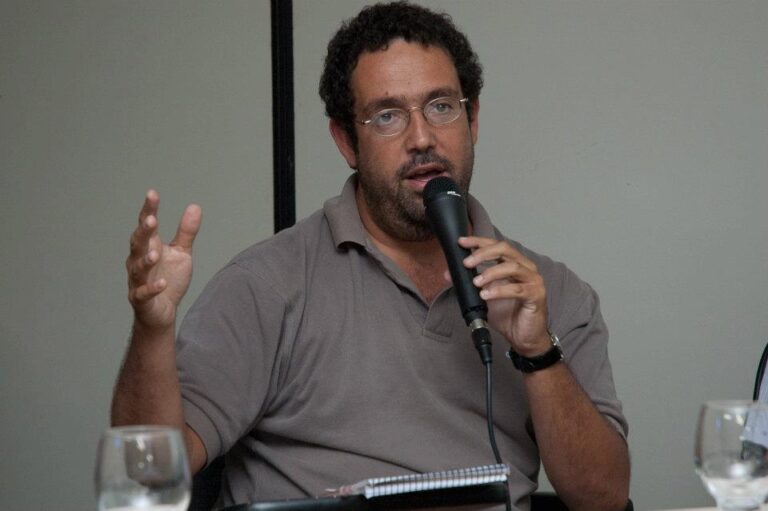
Bruno Beaklini, a political analyst, professor of international relations, and Arab-Brazilian journalist, is a prominent voice in this evolving discourse. A committed libertarian socialist, Beaklini engages in both theoretical and grassroots platforms, drawing on anti-colonial traditions and a deep understanding of the Middle East. His commentaries are featured across Latin American, Spanish, and Arabic media, where he connects global geopolitics with local resistance narratives.
In this exclusive interview with the Organization for Defending Victims of Violence (ODVV), Beaklini analyzes the recent aggression against Iran through the lenses of scorched-earth policy, the failures of international institutions, and the strategic imperative of South–South cooperation. With clarity and historical depth, he draws connections from the fascist invasions of the 20th century to today’s asymmetric wars—and envisions pathways for collective justice and deterrence rooted in the shared interests of the Global South.
The full transcript of this important exchange follows:
1- In light of the Israeli military attacks on Iran beginning 13 June 2025, which have led to the death of over 1,100 civilians and thousands of injuries, how do you assess these actions under international law, especially Article 2(4) of the UN Charter which prohibits the use of force against the sovereignty of another state? How do you view the invocation of Article 51 by Israel and the U.S. as a justification?
Israel and the US invoke Article 51 in the 12-Day War against Iran in a manner very similar to that of Nazi Germany’s first invasions of Austria, Bohemia, and Poland. This is a mixture of alleged “regional threat” and imperial arrogance, considering that existential risk is a constant concern for the colonial entity composed of imported populations. Unfortunately, international law, always weakened by the global power system still under Western hegemony, finds itself demoralized by such hypocrisy and double standards.
2- From a security and defense policy perspective, what does Israel’s pattern of targeting civilian infrastructure—such as hospitals, ambulances, water systems, and pharmaceutical production—suggest about its strategic doctrine and military objectives in this conflict?
The central idea of both Israel and the US is scorched earth. The United States applied this doctrine in Vietnam and Central America. At the same time, they are betting on regime change with a kind of permanent social destruction, as they did in Indonesia in the 1960s – with the overthrow of Sukarno in 1967 in Indonesia and the subsequent devastation of the infrastructure in Iraq, resulting in more than a million deaths in both campaigns. Israel adopts this same principle of provoking a defeat in society and in the relationship between rulers and ruled, government and citizens. In this case, in the war of aggression against Iran in June 2025, they failed to achieve their objectives.
3- Given your background in international political economy and Global South analysis, how do you interpret the systemic alignment of major Western powers with Israeli militarism? To what extent does this reflect structural inequalities and asymmetries in the international system, particularly in relation to multilateral institutions?
Israel is the only country in the world that can afford to wage a war without repayment. Not even the United States has this capacity, considering that it is at least obliged to generate more public debt, hence the need to ensure that the world’s reserve currency is the dollar. The Zionist regime was resupplied mid-war, receiving 12 F-35s within five days of aggression against Iran. This inequality also manifests itself in international institutions, making any hypocritical rhetoric from the United States merely dangerous propaganda.
4- How do you evaluate the response—or lack thereof—by the UN Security Council to the Israeli aggression, in light of its mandate to maintain international peace and security? What reforms or alternative frameworks might better serve the interests of states in the Global South?
The UN Security Council is completely demoralized, especially due to the United States’ veto power, shielding Israel from paying for its ongoing crimes and perpetuating genocide and apartheid. The only “way out” is to replicate NATO’s mutual protection agreement, but within the Global South. A good initiative could replicate this mutual protection framework within the Shanghai Cooperation Organization’s security area. This would be an example of how to prevent the US, Israel, and NATO from exercising their monopoly on force.
5- The extrajudicial killings of Iranian scientists, medics, and rescue workers by Israeli forces have been condemned by various international observers. What mechanisms of transnational justice or international accountability—beyond the often-paralyzed ICC—do you believe are feasible or necessary in such cases?
Unfortunately, I consider myself a skeptic regarding international instruments of law and justice. Nor is it intellectually responsible to advocate for justice by one’s own efforts. But it is a fact that the ICC doesn’t work, has no enforcement power, and is constantly being demoralized. It would be necessary to agree on a new international legal agreement, at least among the blocs, and also reorganize the Interpol system and similar mechanisms.
6- How do you assess the role of arms trade and defense-industrial relations between Israel and Western countries—especially the U.S., Germany, and the UK—in perpetuating impunity and fueling aggressive wars? Should these relationships be redefined under international arms control norms?
It may seem repetitive, but international law has no power to impose itself on defense matters. It’s not like IATA – the International Commercial Shipping Association – or even international maritime trade agreements. If the defense industry and trade were regulated, the United States and its allies would inevitably lose a factor in projecting power in the face of the advanced Asian industrial economy. Ideally, states convicted of crimes against humanity, apartheid, and genocide, such as Israel today and supremacist South Africa in the 1970s and 1980s, would never be able to trade with other nations, much less in sensitive trade, defense, or security matters. But these idealizations of international norms are also the result of a new balance in the planet’s balance of power. Perhaps with the advancement of the Asian and Eurasian economies, we could reach this level of legality within a decade.
7- As an academic and public intellectual from Latin America, how do you view the solidarity landscape within the Global South regarding Palestine, Iran, and the struggle against militarized imperialism? What steps should be taken to enhance independent geopolitical agency among Southern nations?
At this point, I believe we could make further progress. Latin American civil societies are already very supportive of Palestine, and Iran’s image is improving. But it still falls short of its real potential, considering that we have millions of Arab descendants in Latin America, forming considerable communities in Brazil, Argentina, and Chile, in addition to the Arab and Palestinian presence in Central America. The presence of Iranian media in our countries is growing, but it is still incipient in the face of Zionist and pro-US hegemony. This presence in social relations may even imply a new foreign policy framework, and for this, in addition to import and export trade, two movements are necessary: powerful cultural institutions with significant participation and funding (seeking the training of bilingual or trilingual intellectuals); the greater dissemination of Arabic and Persian languages (similar to Chinese initiatives); and, in parallel, the creation of binational companies (joint ventures) in areas of technological advancement. Iran specializes in satellite production, and Brazil, for example, despite having an industrial park and centers of excellence in the aerospace sector, still lacks satellites. This could be a shared interest that impacts joint development.