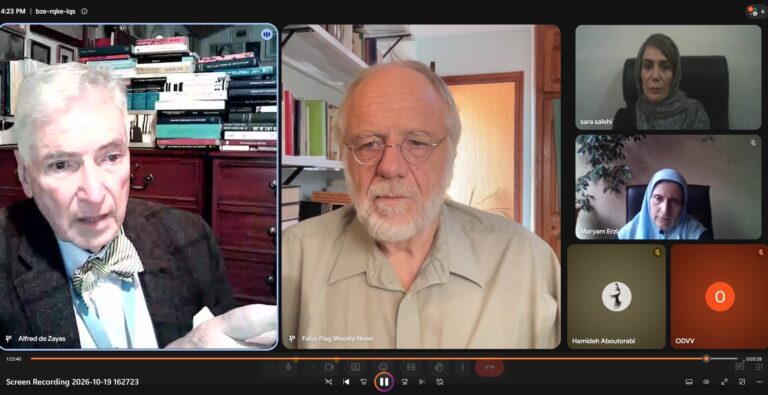
On Monday, 19 October 2026, the Organization for Defending Victims of Violence (ODVV) held an online webinar titled “War, U.S. Sanctions, and Human Rights: The Humanitarian Impact on Iran.” The discussion examined the humanitarian consequences of U.S. sanctions and military attacks against Iran, the question of international accountability, possible avenues for legal action, and the role of media narratives in shaping public understanding of war.
Dr. Kevin Barrett, an American writer, journalist, and political commentator, holds a Ph.D. in Arabic and Islamic Studies from the University of Wisconsin–Madison. His work has addressed the Middle East, international politics, media narratives, and the political and humanitarian consequences of war.
Professor Alfred-Maurice de Zayas is an international lawyer and Professor of International Law and History at the Geneva School of Diplomacy. From 2012 to 2018, he served as the United Nations Independent Expert on the Promotion of a Democratic and Equitable International Order. He previously held senior positions at the Office of the UN High Commissioner for Human Rights and served as Secretary of the UN Human Rights Committee and Chief of its Petitions Department. His contribution to the webinar focused on the legal status of unilateral coercive measures, their humanitarian consequences, and possible avenues for accountability.
The views expressed by the speakers are their own and do not necessarily reflect the official position of the Organization for Defending Victims of Violence.
Kevin Barrett: Sanctions, Civilian Harm, and the Definition of Terrorism
Barrett began by discussing the definition of terrorism. He described it as violence against civilians intended to create fear and achieve political or ideological objectives. Applying this definition to the issues under discussion, he argued that U.S. sanctions and military attacks on civilian targets should be examined in terms of the harm they inflict on ordinary people. He maintained that restrictions affecting access to medicine, medical equipment, and food place pressure directly on the civilian population. Barrett said he viewed these measures as an effort to make life increasingly difficult for Iranians and to pressure them into accepting political change.
Addressing the 40-day war against Iran, Barrett referred to the attack on the Minab school and the deaths of schoolchildren, as well as reported attacks on residential buildings, bridges, railway stations, communications towers, desalination and water facilities, wheat storage facilities, healthcare sites, and energy infrastructure. He characterized these as attacks on civilian infrastructure. He also described public threats by Donald Trump against Iran’s bridges, electricity grid, water facilities, and energy infrastructure as threats to commit war crimes.
During the question-and-answer session, Barrett was asked whether international courts could provide a meaningful path to justice when powerful states refuse to comply with international law. He criticized the practical limitations of the International Criminal Court and the International Court of Justice in compelling the United States to accept adverse decisions. However, he clarified that this did not mean the courts should be abandoned. In his view, submitting evidence and pursuing legal cases remain important because they document alleged violations and bring them to the attention of global public opinion.
Barrett also emphasized the importance of presenting Iran consistently as a party seeking the equal application of international law. He argued that documented accounts of civilian harm, supported by independent reporting and public advocacy, could help challenge selective media narratives and strengthen demands for accountability.
Alfred de Zayas: Unilateral Coercive Measures and Human Rights
De Zayas began by distinguishing unilateral coercive measures from sanctions authorized by the UN Security Council. He argued that measures imposed unilaterally by individual states outside the Security Council framework should not be treated as lawful sanctions. In his view, such measures conflict with the UN Charter, state sovereignty, and international legal obligations. He characterized them as a form of economic coercion and unconventional warfare, referring to Article 2(4) of the UN Charter, which prohibits the threat or use of force.
Referring to resolutions adopted by the UN General Assembly and the Human Rights Council, de Zayas said that unilateral coercive measures have repeatedly been condemned within the UN system. He argued that their effects extend far beyond trade and economic activity, affecting access to medicine, medical equipment, food, and other essential goods. He also highlighted the role of secondary sanctions and over-compliance by third parties in intensifying these effects. According to de Zayas, such measures can undermine fundamental rights, including the rights to life, health, and development.
Citing research, including studies published in *The Lancet*, de Zayas referred to estimates linking unilateral coercive measures to hundreds of thousands of deaths worldwide each year. He also discussed the findings of former UN Special Rapporteur Alena Douhan following her official visit to Iran in 2022. Her work examined the effects of unilateral measures, secondary sanctions, and over-compliance on Iran’s economy and on a broad range of human rights. De Zayas called for greater follow-up on Douhan’s reports and guidelines and for more attention to the humanitarian consequences of these measures.
Proposed Legal Avenues and the Question of Compensation
A substantial part of de Zayas’s presentation focused on possible avenues for legal action. He proposed examining cases before the International Court of Justice on the basis of relevant treaties, as well as seeking an advisory opinion from the Court on the compatibility of unilateral coercive measures with the UN Charter and international law. He also raised the possibility of pursuing relevant matters through the International Criminal Court and the UN Human Rights Committee, including individual and inter-state complaint procedures where the applicable jurisdictional requirements are met.
De Zayas argued that responsibility should not be considered only in relation to states that impose unilateral measures. States and entities that assist in implementing measures alleged to be unlawful should also be examined in light of the rules on international responsibility. He suggested that Iran and other states could work through the UN General Assembly and cooperate with countries within BRICS and the Shanghai Cooperation Organisation to advance a request for an advisory opinion from the International Court of Justice. These were presented as possible avenues for further examination, with each requiring an assessment of jurisdiction and admissibility. De Zayas also stressed that collective punishment and the use of starvation as a method of warfare are prohibited under international law. He argued that these prohibitions must remain relevant in both conventional armed conflict and forms of unconventional warfare. He characterized the attacks against Iran in June 2025 and on 28 February 2026 as aggression and perfidy, and called for civil and criminal accountability and compensation for the harm caused.
International Accountability, Media Narratives, and UN Reform
De Zayas criticized what he described as a culture of impunity surrounding violations of international law by powerful states. He argued that the absence of clear condemnation and effective follow-up weakens the credibility of international institutions. While acknowledging serious shortcomings in the UN system, he maintained that the United Nations remains a necessary forum for multilateral dialogue and action. The central problem, in his view, is the lack of effective mechanisms to implement recommendations and ensure that documented violations lead to practical consequences. He also criticized the role of Western media in shaping a selective account of international events. According to de Zayas, dominant narratives often present the United States and Europe as defenders of the international order while portraying Iran and other societies under pressure as the source of instability. He called on independent scholars, journalists, and civil society organizations to help challenge such narratives by presenting evidence, explaining the human consequences of war and economic coercion, and sustaining demands for accountability.
In the final part of his remarks, de Zayas discussed the need to reform international institutions and follow up on the recommendations of human rights experts. He argued that the veto should not be used to shield states from criticism or sanctions and should instead be exercised consistently with the purposes and principles of the UN Charter. He also emphasized the role of civil society in pressing for the implementation of recommendations made by UN experts and in pursuing available legal avenues. The webinar brought together two complementary perspectives: Barrett’s analysis of the pressure placed on civilians, the targeting of essential infrastructure, and the role of public opinion; and de Zayas’s examination of unilateral coercive measures, state responsibility, and possible avenues for legal accountability. The discussion highlighted the importance of documenting civilian harm, drawing attention to the human consequences of military and economic measures, and pursuing accountability through international forums.