International Legal Perspectives on Civil Unrest and External Intervention: An Interview with Professor Emily Crawford
In response to the recent developments in Iran in early January 2026—events that began as civil demonstrations but escalated amid organized armed involvement and external interference—the Organization for Defending Victims of Violence (ODVV) conducted a specialized legal interview to clarify the international legal dimensions of these unfolding dynamics. As part of its mandate to promote accurate legal analysis and counter distorted narratives, ODVV sought expert insight from one of the leading authorities in the field.
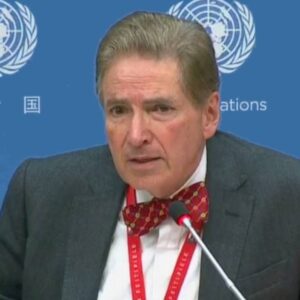
Professor Emily Crawford, a leading scholar of international law, international humanitarian law, and international criminal law at the University of Sydney Law School, joined the Organization for Defending Victims of Violence (ODVV) for an in‑depth discussion on the legal complexities surrounding recent events in Iran. With extensive academic and practical expertise in the law of armed conflict, the classification of violence, and state responsibility, Professor Crawford offers a rigorous legal framework for understanding situations that fall between peaceful protest and armed confrontation.
In this interview, she addresses several critical themes, including:
- The scope and limits of the principle of non‑intervention
- Legal thresholds distinguishing civil demonstrations from non‑international armed conflict
- Obligations of states and third parties toward civilian protection
- Whether current international legal mechanisms adequately address “grey‑zone” situations
Her insights provide a structured legal lens for evaluating claims of foreign involvement, the nature of organized violence, and the responsibilities of states under international law.
The views expressed in this interview do not necessarily reflect the official positions of the Organization for Defending Victims of Violence.
The full transcript of this important exchange follows.
1. From an IHL and general international law perspective, how should the principle of non-intervention be assessed when external actors are alleged to have influenced the internal trajectory of civilian protests in a sovereign state?
Non-intervention is subject to significant debate as to its parameters with a broad reading saying it’s any unwanted involvement in a foreign State’s affairs to a more narrow assessment which would say only those forms of intervention that get to the level outlined in Nicaragua – so funding civilian protests in another State, sending people to protest etc. but that wouldn’t go so far as to include support for protestors. So, I think you’d have to say that generalized support for protestors (like States have done recently with the Iranian protestors) would not amount to a violation of the principle of non-intervention but that funding such protests or providing other tangible support on the ground probably would.
2. What legal standards exist to distinguish peaceful civilian demonstrations from situations that evolve into non-international armed conflict, particularly where the involvement of organized armed elements is alleged?
In IHL it’s found in Protocol II – that the Protocol would not apply to ‘riots, isolated and sporadic acts of violence and other acts of a similar nature’ – so anything that lacks a degree of organization (i.e. that there is an organizational policy to both the violence and to the perpetrators) would not apply. The rules have been well-developed in the case law of the ICTY and explain in detail what is require to distinguish protests – even violent protests – from NIAC – so the kinds of weapons, the targets, the organizational structure of the armed group etc.
3.In such contexts, what are the obligations of states and third parties regarding the protection of civilians and the prohibition of indirect participation in internal hostilities?
There is no international law prohibition on participation (either direct or indirect) in NIAC by civilians – they just don’t enjoy any special protections for such participation and will lose their civilian immunity for as long as they participate. In terms of States and NIAC, State are governed by the general rules on State responsibility and any relevant international human rights law – though the complication there is that there are jurisdictional limitations regarding the application of IHRL. If they intervene, they might be considered parties to the conflict and would then be bound by existing IHL rules on the protection of civilians. If they were only involved tangentially and not to a level that it could be considered a party to the conflict, they will still be bound by the rules on State responsibility if they violate international law
4. Do you see current international legal mechanisms as sufficient to address these grey-zone situations, or is there a normative gap in IHL when unrest does not neatly fall within classical armed conflict categories?
I don’t think the problem is the law – the intersection of IHL and human rights law has enough in it to provide sufficient protections – it’s always just a matter of compliance by the State and enforcement and accountability – the rules are there, there is just frequently the unwillingness to follow those rules.