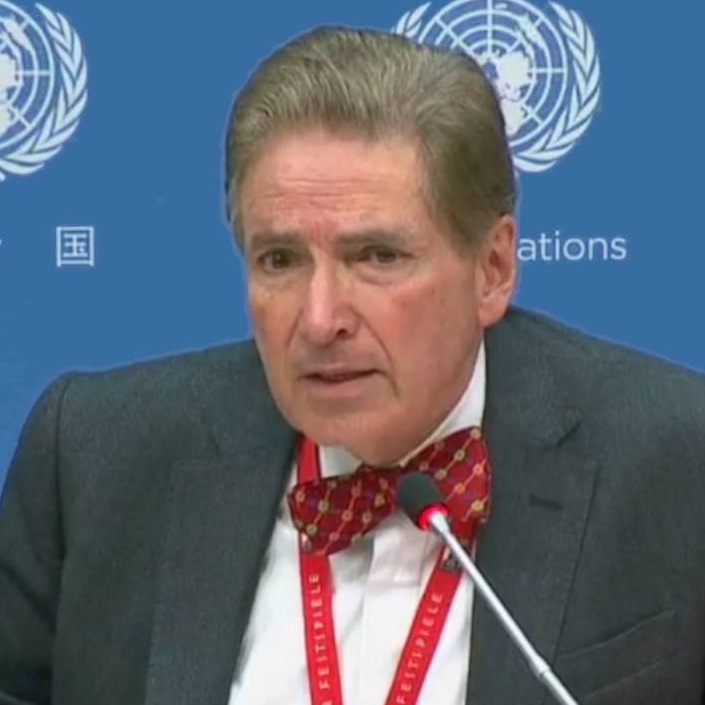
As part of its ongoing efforts to document grave violations of human rights and international humanitarian law arising from the recent military aggression by the United States and Israel against Iran, and to advance international human rights discourse through engagement with prominent global experts, the Organization for Defending Victims of Violence (ODVV) conducted an exclusive interview with Alfred de Zayas on 21 June 2026.
Alfred-Maurice de Zayas is a former United Nations Independent Expert on the Promotion of a Democratic and Equitable International Order (2012–2018), former senior lawyer at the Office of the United Nations High Commissioner for Human Rights (OHCHR), former Secretary of the UN Human Rights Committee, and former Chief of the Petitions Department. He holds a J.D. from Harvard Law School and a doctorate in modern history from the University of Göttingen. He is the author of numerous books and scholarly publications on international law, human rights, self-determination, and the United Nations system, and is widely recognized as one of the leading international experts on international legal order and multilateralism.
In this interview, de Zayas examines the legality of the recent military attacks against Iran under the UN Charter, the prohibition of aggression, and the law governing the use of force. He discusses the responsibility of states for violations of international law, the effectiveness of existing accountability mechanisms, the humanitarian consequences of unilateral coercive measures, and the challenges posed by selective enforcement of international law. He also reflects on the broader crisis facing international institutions and offers proposals for strengthening multilateralism, diplomacy, and respect for the principle of sovereign equality among states.
The views expressed in this interview do not necessarily reflect the official positions of the Organization for Defending Victims of Violence.
The full transcript of this interview follows:
1. The recent military attacks against Iran took place while diplomatic negotiations were still ongoing. From the perspective of the UN Charter and the prohibition of the use of force, how should the international community assess the legality of initiating military action under such circumstances? What mechanisms, if any, exist to ensure accountability for violations of the prohibition of aggression?
The UN Charter obliges all States to settle disputes by peaceful means, that means to negotiate in good faith pursuant to article 2(3) of the Charter. The prohibition of the use of force without Security Council approval is absolute, the only exception being self-defence under article 51 of the Charter, following an armed attack. This means that Iran had a right of self-defence against the US and Israel in June 2025, when Iran was attacked by the US and Israel. But neither the US nor Israel could invoke article 51, because they were the aggressors, not the victims of aggression.
Article 2(4) of the Charter prohibits not only the use of force, but also the threat of the use of force, e.g. all the US provocations, sabre-rattling and sending of a naval armada to the Gulf.
The crime of aggression is laid down in Article 5 of the Statute of Rome of the International Criminal Court. It follows the definition of aggression adopted at the Kampala meeting of the Assembly of States parties to the ICC statute. The attacks on Iran in June 2025 and February 2026 constituted aggression for purposes of the ICC statute, and also within the meaning of the Declaration on Aggression contained in General Assembly Resolution 3314.
The ICC has received information on these crimes and the Prosecutor should initiate an official investigation pursuant to article 15 of the Statute of Rome. Thus far he has not done so.
The circumstances of the attacks in June 2025 and February 2026 constituted the separate and discrete crime of “perfidy”, which has been part of customary international law for centuries and prohibited in the Hague and Geneva Conventions. The most clear condemnation of perfidy is included in article 37 of Additional Protocol I to the Geneva Conventions (1977).
The only binding mechanisms in the UN system are stipulated in Chapter VII – either economic sanctions or multilateral enforcement on the basis of a UN resolution. Alas, because of the Veto power in article 27 of the UN Charter, there is zero chance to get enforcement. The US has already abused the veto dozens of times to shield Israel from condemnation and sanctions. Thus, there is no way to punish either the US or Israel. The only possibility lies with the General Assembly that should adopt a “Uniting for Peace” resolution and assume its responsibility for the peace and security of mankind within the scope of articles 10, 11, 12 of the UN Charter. The General Assembly could then propose to the UN membership to BDS both Israel and the United States. Boycott, Divest, Sanction would mean that States should cease purchasing or selling to the US and Israel, no more F-16, F-35, Boeing, Lockheed/Martin, Raytheon, General Motors, Caterpillar etc. No more purchases of US Treasury Bonds. Divesting from US investments. No more sales of “rare earths” to the US or Israel. Most of the world, however, including the Global South go on “business as usual” as if nothing had happened. This is civilisational crisis.
2. During the course of the conflict, a significant number of civilians, residential areas, and civilian infrastructure were reportedly affected. In your view, how effective are existing international legal mechanisms in investigating and addressing alleged violations of international humanitarian law involving civilian casualties and damage to civilian infrastructure?
The mechanisms are there, the political will is lacking. Not even the Organization for Islamic Cooperation, the Arab League, the African Union have taken appropriate diplomatic, political or economic action. These violations should be submitted to the International Court of Justice (not the same as the ICC) under a number of treaties containing compromisory clauses. In some extreme cases, e.g. the bombing of the girls’ school in Minab, maybe an action under the Genocide Convention, Art. IX, could be initiated, taking the precedent example of South Africa v. Israel (2023 – still pending)
The Prosecutor of the ICC could take action motu proprio pursuant to the Statute of Rome. No such investigation has been started, no indictment is in sight. The US and Israeli deliberate attacks on civilian infrastructure, mosques, hospitals, UNESCO World Heritage sites – all constitute war crimes (Art. 8 Statue of Rome), and some cross the threshold into crimes against humanity (art. 7 Statute of Rome)
3. Throughout your work as UN Independent Expert on the Promotion of a Democratic and Equitable International Order, you frequently addressed the human rights impact of unilateral coercive measures. When comprehensive economic sanctions operate alongside armed conflict, how should international law evaluate their cumulative humanitarian consequences, particularly regarding access to healthcare, medicine, and other essential civilian needs?
The UN General Assembly adopts yearly resolutions condemning UCMs as contrary to the UN Charter and international law, freedom of navigation, freedom of commerce, an illegal interference in the internal affairs of states, a violation of sovereignty, etc. The most recent resolution was 80/250, adopted in 18 December 2025. Similarly, the UN Human Rights Council adopts yearly resolutions condemning UCMs, most recently in Resolution 61/6 of 27 March 2026. Studies by scholars including Prof. Jeffrey Sachs, Marc Weisbrot and the British medical journal The Lancet have published studies demonstrating that UCMs are directly responsible or the deaths of hundreds of thousands of individuals worldwide – ever year.
On 25 March 2024 I spoke before the UN Security Council on the Illegality of UCMs and published an article thereon in Counterpunch
https://www.counterpunch.org/2024/03/27/un-charter-un-credibility-and-unlawful-unilateral-coercive-measures/
4. Many observers express concern that repeated violations of international law often go unpunished when powerful states are involved. To what extent does selective accountability undermine confidence in the international legal order? What reforms or developments do you believe are necessary to strengthen respect for international law, the UN Charter, and the principle of equal sovereignty of states?
One of the most serious consequences of the repeated violations of international law by powerful states – in total impunity – is that the authority and credibility of international institutions are undermined. The question is raised by many, whether the U.N. and other international institutions really serve a purpose, whether the world can rely on them. The ready answer is that the institutions are currently dysfunctional, and unless reformed, they may as well be abolished. On the other hand, if the UN did not exist, we would have to create another forum for multilateral debate, since blab la is always better than boom boom. And if the UN only serves as an escape valve, as a venue where states can let off steam, that is already something. Indeed, we may not be here today if the UN had not facilitated the quid pro quo – the settle of the Cuban missile crisis of 1962.
I am someone who all his life believed in international law and human rights. I’m not giving up. I still believe in the necessity of both. In my 2013 report to the General Assembly I submitted concrete, implementable, pragmatic proposals how to fix the system. Of course, there was no follow-up. What we all need is a Global Compact on Education for Peace and Empathy, a renewed commitment to diplomacy, to dialogue, to mutual respect. This is difficult when governments are led by megalomaniacs and malignant narcissists. I recommend the excellent book by Richard Falk and Hans von Sponeck, Liberating the United Nations, Realism with Hope, Stanford University Press, 2025.