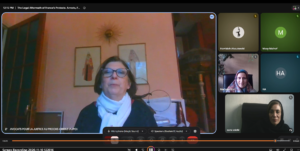
ODVV Exclusive Interview: Helena Cobban notes, the Israeli cross-border aggression against Iran should not be seen as an isolated act of war, but rather a continuation of centuries-old settler-colonial projects rooted in coercion, racial supremacy, and geopolitical domination.
In the aftermath of the October 7 attacks and the ensuing catastrophic military campaign by Israel in Gaza—which left tens of thousands of Palestinians dead and entire neighborhoods in ruins—the international community failed to hold the aggressors accountable or halt the violence. Emboldened by this impunity, Israel escalated its regional operations, launching a devastating military assault on the Islamic Republic of Iran between June 13 and June 24, 2025. While the physical damage stretched from Tehran to Isfahan, targeting nuclear facilities, hospitals, humanitarian infrastructure, and media offices, the political and legal implications resonated far beyond.
As Helena Cobban notes, the Israeli cross-border aggression against Iran should not be seen as an isolated act of war, but rather a continuation of centuries-old settler-colonial projects rooted in coercion, racial supremacy, and geopolitical domination. Her analytical framing situates Israel within the historical context of Western empire-building, emphasizing how violence and impunity remain central tools of maintaining control over non-Western societies.
Cobban, a British-American scholar and author of seven books, has reported on the region since the 1970s. After moving to the United States in 1982, she has consistently contributed to international understanding of the Palestinian struggle, post-war accountability, and the broader legacy of colonial violence. A committed member of the Quaker religious community, her writings emphasize the ethical dimensions of global politics and the need for nonviolent paths to justice. She has been the Executive Director of the Just World Educational Foundation, a nonprofit organization based in the United States. She continues to share her analysis on her long-standing blog, Just World News, and serves as a Senior Fellow at the Center for International Policy in Washington, D.C.
In light of her extensive expertise and longstanding commitment to ethical international engagement, the Organization for the Defense of Victims of Violence (ODVV) conducted an interview with Ms. Cobban to examine the legal, strategic, and historical dimensions of the June 2025 Israeli aggression against Iran.
The full transcript of the interview is provided below:
1. In light of Israel’s military aggression against Iran—beginning on June 13, 2025, and resulting in the deaths of over 1,100 civilians and widespread destruction of civilian infrastructure—how do you interpret this attack through the lens of settler-colonial continuity and the regional strategy of destabilization? What historical or ideological patterns do you see being replicated in this new front?
A few years ago, I started a project to look systematically at the origins of the phenomenon by which a handful of “White”, West-European-origined states came to dominate the entire global system– that, even though the peoples of majority “White” states then as now constituted only around 10% – 12% of humankind. The “White” states were able to achieve their world domination by imposing their always violent, settler-colonial projects on non-“White” peoples and communities on all the world’s continents. Violence, the deliberate use of cruelty against non-“White” peoples, and also crucially the ability to “get away from” the consequences of their actions lay at the heart of those transoceanic, settler-colonial projects.
The five main “White”, transoceanic empires of the modern historical era were emerging nation-states that were all perched on the western (Atlantic) coast of Europe. In chronological order, they were: the Portuguese, Spanish, Dutch, English/British, and French empires. What allowed the architects of these projects to build their empires were their command of sturdy, long-distance ships and strong navigational techniques (often learned from Muslim navigators); their command of advanced naval gunnery and the techniques of using it; and the ability they thereby gained to speedily “escape”, physically, from suffering the ire or retribution of their victims. That was unlike the many land-based empires throughout history, whose masters always, after the end of battles, had to find a way to coexist with neighbors on the same land-mass, whether those neighbors had been fully subjugated or not. In that context, the commanders of the sea-based “White” empires very frequently felt they could– indeed, should– use extreme and exemplary violence and cruelty as a way to punish the Indigenes they encountered.
Israel is quintessentially a settler-colonial project, though an intriguingly late-born one. It has always been deeply embedded within the sinews of “White” empire. Since before 1948 its leaders have acted on the bases of: maintaining technological superiority; their ability to “get away from” encountering any pushback from its victims (in both geographic and geopolitical terms); and an often active desire to deliberately use cruelty to discipline or punish the Indigenes of West Asia. In their own rhetoric, they tend to focus on goals like “re-establishing the ‘credibility’ of Israeli deterrence”, which is a way of connecting with broader modern (and mainly Western) discourse of “deterrence” in the sphere of defense policy. But actually, their actions against Iran over the past year and especially in June 2025, like their actions against their immediate neighbors in West Asia, hark back much more strongly to the kinds of punishment campaign that the Spanish conquistadores (and later, the Anglo-based settlers in North America) enacted against Native people of the Americas, or the French launched against Algerians, or the British against Afghans or Chinese, the Americans in Vietnam, and so on…
2. As someone who has studied post-war justice mechanisms, how do you assess the current institutional capacity of bodies such as the UN Human Rights Council or the International Criminal Court to address ongoing violations in Iran and Palestine? What reforms or realignments might be needed for these bodies to fulfill their mandates in an era of great power impunity?
Since the UN Human Rights Council is a body of the UN, its effectiveness is tightly hobbled by the geopolitical (im-)balance under which the broader UN operates. Many of its Special Rapporteurs have, over the years, done an important job of documenting many gross violations of essential human-rights principles. But that documentation will remain little more than words on paper unless and until the broader decision-making bodies within the UN– at this point, primarily, the Security Council– takes serious action to end the gross rights violations as well as, crucially, the conflicts that have provided the environment within which they are committed.
As for the ICC, this is a treaty body whose jurisdiction is limited to the territories of states that are party to it (which Palestine is, though Israel– like the USA and many other states, including Iran– is not.) In the 1990s, I’d been a big supporter of a body that, like this one, held the promise of being able to hold accountable national leaders responsible for the commission of gross atrocities in various contexts. Over time and through my own research I came to the conclusion that the ICC fell far short of that ideal. It was mainly a European project to try to punish certain leaders in– mainly– Africa of whom the Europeans did not approve. It is true that the ICC has issued indictments against PM Netanyahu and his former defense minister; but those indictments have had zero impact on the continued support that the USA and most European governments themselves have continued to give to Netanyahu’s policies and projects in Gaza and elsewhere. I think it’s probably not worth the trouble of discussing how to reform the ICC. The billions of Euros that go into its budget– most of which flows to very highly paid lawyers from majority-“White” countries- would be much better spent supporting the repair of the many countries in Africa and elsewhere in the Global South that have been ravaged by European wars and colonialism.
3. Given your longstanding commitment to nonviolent resistance and your deep knowledge of Palestinian history, what potential do you see for building cross-border movements of solidarity in response to Israeli aggression in both Palestine and Iran? Can the experiences of civil society in the Global South offer models for ethical internationalism in this context?
Yes, there is a strong potential for continuing to build cross-border movements of solidarity in response to Israeli aggression in both Palestine and Iran. But this potential is far too often stymied– especially within West Asia itself– by the actions of governments that feel deeply threatened by such movements, and whose leaders consider themselves almost totally reliant on Western backing. I think it requires a combination of both governmental and non-governmental action at the global level to shift this reality. For example, Chinese diplomacy (along with some other very significant factors) has managed to shift the alignment of many/most GCC countries away from the knee-jerk hostility to Iran they displayed a decade ago.
My hope is that smart, ethical, and coordinated actions at the levels of formal diplomacy, economic actions, and civil-society activism may continue to curtail the “freedom of cruel, coercive action” that Israel has enjoyed in the region for so long and can start to roll back Israel’s horrifying violent regional project. But I fear this may not happen in time to save the lives of most of Gaza’s people.
4. Israeli and U.S. officials have invoked Article 51 of the UN Charter to justify the attacks on Iran. However, many legal scholars argue this interpretation circumvents Article 2(4) and the core principles of state sovereignty. In your view, how does this legal manipulation intersect with Western media narratives and the broader discourse of “rules-based order”?
Israel’s claim to have been acting in “self-defense” against Iran under, presumably, Article 51, is complete nonsense. Israel’s many networks of powerful supporters in the West routinely invoke its “right of self-defense” to justify each and every one of its violent and coercive actions, though it is almost certain that the majority of citizens of Western countries– like nearly everyone else around the world– understands every well that the Israeli claims of “self-defense” are hogwash.
At the global level, there was a time when the U.S. government, under Pres. Biden, would repeatedly claim strong fealty to the concept of a “rules-based order.” (Though Biden and his people never really spelled out which “rules” they wanted to act by. Their protestations of support for the RBO always had a rote quality.) Under Pres. Trump, Washington has undergone a significant shift. He and his people exhibit outright contempt for the UN and for any suggestion that the USA should abide by any body of supranational rules whatsoever. Of course, this gives yet more permission for the lawbreakers of Tel Aviv to flout all of international law.
5. Israel has systematically destroyed hospitals, water systems, pharmaceutical factories, and humanitarian aid vehicles in Tehran—mirroring tactics previously used in Gaza. What communicative or strategic logic lies behind targeting humanitarian infrastructure? How has the global media environment contributed to normalizing such practices?
The main logic that seems have informed all of Israel’s deliberate targeting of non-military targets, including those that are expressly protected under international humanitarian law like hospitals, emergency service responders, and so on, seems to have been not only to inflict harm that affects entire communities but also to publicly demonstrate its willingness to commit cruel and grossly violative acts, the broad impunity with which it does so, and its readiness/willingness to continue to commit such acts in the future on perhaps an even broader, more cruel, and more harmful scale. This has been especially true of its actions against the relatively small and extremely vulnerable population of Gaza, but can also be seen in its actions against some of these kinds of “targets” in Iran. (In both contexts, it is important to remember that in IHL the same protections that are accorded to non-military personnel are also accorded to military people who are clearly not on duty– for example, when they are visiting their families– and who are thus noncombatants.)
One major example of the communicative function of Israel’s violence was given by the former Israeli security-affairs official Chuck Freilich when he told an Al-Jazeera documentary-maker in 2024 that though it was difficult to see some of the destruction the Israelis had inflicted in Gaza, still there was some “hope” that when the Gaza Palestinians continued to see the extent of that destruction they might change their allegiances and turn against the Resistance.
As for the role of global media, it is true that the big corporate media outlets in the “West” have worked to obfuscate and hide the realities of what Israel was doing in Gaza– and to make almost no mention of the anti-humanitarian aspects of Israel’s actions against Iran. In reporting the situation in Gaza, for example, they refer to “the food crisis in Gaza”, or just “casualties” there, without spelling out that it is Israel that has inflicted that situation.
However, at the global level those legacy “Western” media outlets certainly no longer enjoy the near-monopoly on news reporting that they once enjoyed; and even within Western nations, those outlets’ once-dominant role is challenged from many sides including from the emergence of newer media platforms that are much more ready to actively challenge Israel’s official narrative. Polling data within the USA and other Western nations now indicates a severe drop in the support that Israel (along with, presumably, most of its key narratives) enjoys in these countries.
This is, of course, a very welcome shift, though it is very, very long overdue. But the challenge remains to be able to unite and organize the newly energized constituencies that are critical and questioning of Zionism, or even actively opposed to it, into a political force that is capable of shifting government policy. That is why I think we need a concerted effort by all the popular movement and governments worldwide that are prepared to work together to bring a speedy and definitive end to all of Israel’s cruel scofflawry in Gaza and elsewhere throughout West Asia, and to restore to the United Nations the lead role that the peoples of the world want and need it to have in the restoration of all the rights of the Palestinian people and the other peoples of the region.