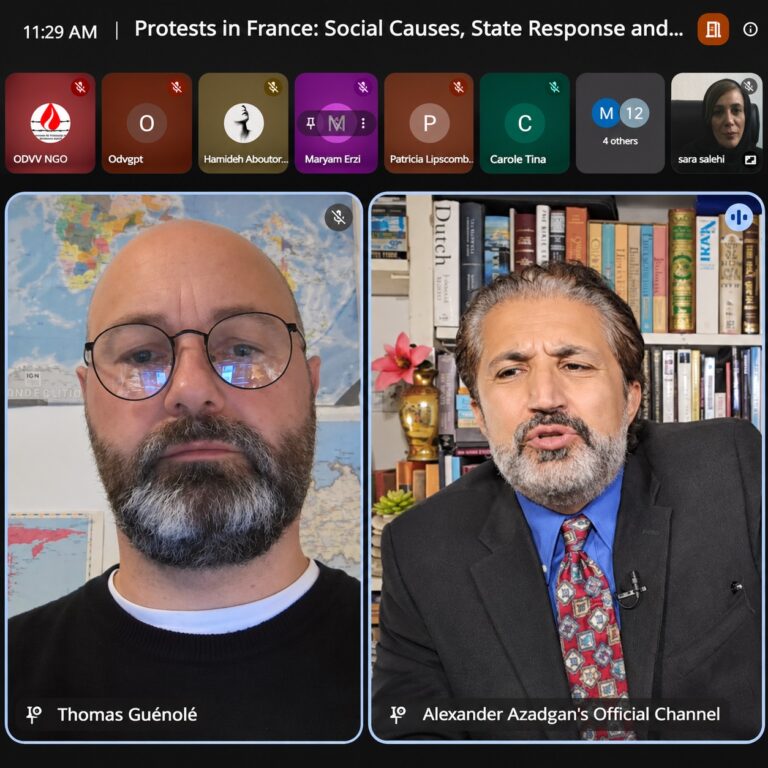
On Tuesday, 3 November 2026, the Organization for Defending Victims of Violence (ODVV) held a webinar titled “Protests in France: Social Causes, State Response and Human Rights.” Professor Alexander Azadgan and Dr. Thomas Guénolé discussed the background to the protests, their portrayal in the media, the authorities’ response, and avenues for addressing human rights violations.
Professor Alexander Azadgan is an American academic and political analyst working in geopolitics, international political economy and business studies. He serves as Chief Geopolitical Counsel at the Center for Geostrategic Studies and contributes to international news channels as a political commentator.
Dr. Thomas Guénolé is a French political scientist and author. He holds a PhD in political science from Sciences Po in Paris and participated in the 2025 Gaza flotilla.
The views expressed during the webinar are those of the speakers and do not necessarily reflect the official positions of the Organization for Defending Victims of Violence (ODVV).
Alexander Azadgan on possible Israeli involvement in the unrest in France
In his presentation, “Did Israel Play a Role in the October 2026 French Riots?”, Azadgan examined foreign influence, information operations and the politics of social unrest. Referring to rising living costs, problems in education and wider social and economic grievances, he stressed that any assessment of foreign influence needed to begin with the domestic circumstances behind the protests. Discussing the French government’s security response, Azadgan cited the reported deployment of approximately 70,000 police officers and gendarmes for the demonstrations on 24 October. He emphasized that France was experiencing domestic tensions before foreign actors became prominent in international discussion of the unrest. Attributing its origins to a foreign government, he said, would require evidence of an operational connection.
Azadgan then examined the role of media and social networks in shaping international perceptions, focusing on Israeli-linked media activity, political statements and misleading content. He discussed an AI-generated image purporting to show an elderly French couple who had been robbed and left in their underwear. According to his account of a media investigation, the image originated from an Israeli website and was subsequently circulated without the disclosure that it had been artificially generated. He said one repost had attracted approximately six million views.
He also discussed President Emmanuel Macron’s response to foreign political commentary on the unrest. In Azadgan’s account, Macron criticized foreign leaders for exploiting events in France while distinguishing between visible foreign interference in the events themselves and subsequent manipulation of information. Citing remarks by French Foreign Minister Jean-Noël Barrot, Azadgan said that approximately two-thirds of social media content linking the violence to immigration narratives originated outside France. He stressed that this figure concerned foreign-origin content collectively and should not be interpreted as the proportion originating in Israel. He also cautioned that foreign origin alone did not establish government sponsorship.
Describing how information campaigns can influence public opinion, Azadgan referred to the amplification of dramatic footage, the circulation of unverified claims and fabricated images, and narratives associating unrest with particular ethnic or religious groups. He argued that such activity could influence the political consequences of protests, deepen distrust in public institutions and recast economic and social grievances as an ideological conflict. Repeated dissemination by seemingly independent accounts, he added, could intensify existing political divisions. Turning to political incentives, Azadgan examined attempts by some Israeli politicians to frame the unrest through narratives about combating Islamist extremism. He identified disagreements between Paris and Tel Aviv over Gaza, humanitarian issues and Palestinian statehood as relevant diplomatic context. In his assessment, the unrest offered opportunities for both domestic political messaging in Israel and efforts to influence international audiences.
Azadgan personally considered intelligence involvement possible, but repeatedly distinguished that view from what the public evidence established. He said the material examined in his presentation did not demonstrate that the Israeli government or Mossad had organized or financed the unrest. Substantiating operational involvement, he explained, would require evidence such as authenticated communications, financial transfers, operational instructions and corroborated testimony. Political benefit alone, he emphasized, did not establish operational responsibility.
Thomas Guénolé’s critical analysis of human rights in France
In his presentation, “A Critical Analysis of the Current Human Rights Situation in France,” Guénolé examined freedom of expression and assembly, discriminatory policing, detention and prison conditions, migrants’ rights, housing and education. Drawing on court judgments and human rights reports, he highlighted the persistence of several problems despite earlier findings and legal proceedings. On freedom of expression and assembly, Guénolé criticized bans on some Palestine solidarity demonstrations and the cancellation of university events.
Referring to Amnesty International’s assessment, he said that three students at Sciences Po had been expelled and ten suspended following Palestine-related protests. He also discussed restrictions on gatherings opposing the A69 motorway project and the initial prohibition of a women’s march in Paris, which was subsequently allowed to proceed following judicial review. These examples, he argued, illustrated how exercising the right to peaceful assembly could require legal intervention.
Discriminatory policing and detention conditions
Discussing police identity checks, Guénolé cited findings published by France’s Defender of Rights in 2025. He said young men perceived as Black, Arab or North African were four times more likely to report having been subjected to identity checks. Despite judicial findings concerning state responsibility for discriminatory checks, he argued, more recent evidence indicated that unequal treatment persisted.
Guénolé also referred to concerns raised by the UN Committee against Torture about numerous allegations of excessive force, its disproportionate impact on people of African or Arab descent and foreign nationals, and injuries caused by certain police weapons. He said the Committee had also examined the expansion of police self-defence provisions and deaths involving police firearms. On prison conditions, Guénolé cited a 2020 European Court of Human Rights judgment involving 32 applications concerning six French prisons. He identified overcrowding, insufficient personal space, poor ventilation, inadequate toilet privacy and restricted exercise among the conditions addressed. He added that concerns about overcrowding and inadequate detention conditions had been raised again by the Committee against Torture in 2025.
Migrant children, migrant workers and access to essential services
Referring to European judgments on the detention of migrant children, Guénolé criticized inadequate conditions and the placement of children with unrelated adults in some border waiting areas. He also said that an inquiry by the UN Committee on the Rights of the Child had identified grave and systematic violations affecting unaccompanied migrant children in France. According to Guénolé, unreliable age assessments and insufficient procedural safeguards could exclude children from protection, accommodation, food, healthcare and education, leaving them exposed to violence and exploitation. He also discussed pushbacks at the French–Italian border, including cases involving unaccompanied children, and stressed the importance of access to an effective asylum procedure.
On migrant workers’ rights, Guénolé referred to an Amnesty International investigation based on interviews with 27 migrant workers of 16 nationalities and 39 specialists, including lawyers, researchers and trade unionists. He said the investigation documented unpaid wages, excessively long working hours, dangerous conditions, violence and racist abuse. Short residence permits, administrative failures and processing delays, he argued, increased workers’ insecurity and exposure to exploitation. Citing an estimate by the Fondation pour le Logement, Guénolé put the number of homeless people in France in 2024 at 350,000. He also addressed forced evictions affecting Roma and Traveller communities, restrictions on Muslim women wearing headscarves in sport, and barriers to education for children with disabilities.
School enrolment alone, he argued, did not demonstrate full access to education when inadequate assistance or necessary adjustments limited children’s attendance. He also criticized involuntary psychiatric admission and treatment, including restrictions imposed through institutional routines without sufficient assessment of individual circumstances.
The scale of student protests and their wider social demands
Guénolé traced the student protests to 31 August in Mayotte. He said that Lycée du Nord had 2,300 students for 900 places and that the poor condition of school buildings was another source of grievance. Parents and teachers joined the protests, which spread to mainland France from mid-September, including Créteil, where teacher shortages were also an issue. With the participation of workers, parents, teachers and some former Yellow Vest protesters, Guénolé said, the movement had expanded beyond educational demands, with the cost of living becoming a central concern.
He gave attendance figures of 450,000 demonstrators on 6 October, 480,000 on 13 October, and 800,000 on each of 17 and 24 October. He also reported 600,000 participants on the Saturday immediately preceding the webinar, despite the holiday period. According to Guénolé, the number of high schools closed because of student blockades or administrative decisions to prevent them rose from 400 on 29 September to 1,800 on 6 October and 2,000 on 8 October. He put the total number of high schools in France at 3,700 and cited these figures as an indication of the movement’s scale.
Criticism of the government response and media coverage
Guénolé described the government’s response as a “strategy of tension.” He said delays in authorizing the route for the 24 October demonstration, followed by its cancellation the night before, had disrupted preparations. He also interpreted the Interior Minister’s remarks about giving police no instructions of restraint in using their weapons as an implicit threat to protesters. He criticized violence against students and peaceful demonstrators, the use of tear gas and arrests. Guénolé also alleged that videos had exposed police provocateurs among demonstrators damaging property, thereby creating a pretext for forceful police intervention.
The presence of a few hundred people involved in violence among hundreds of thousands of demonstrators, he argued, should not justify restricting everyone else’s right to peaceful assembly. He also criticized arrangements under which police officers investigated their colleagues, arguing that these undermined independent scrutiny and effective sanctions. Turning to media coverage, Guénolé cited a TF1 news bulletin on 18 October. He said that 99.1 per cent of the coverage he discussed had focused on violence and maintaining order from the police perspective, while peaceful demonstrations had received only nine seconds, or 0.5 per cent. In his assessment, this distorted public understanding of the protests and the demands of the majority taking part.
Questions on accountability, political exploitation and the future of the protests
Responding to the moderator’s question about addressing human rights violations and the role of civil society, Guénolé proposed an independent body dedicated to investigating police violence. He argued that its investigators should be barred from subsequently entering or returning to active police service, since that possibility could create conflicts of interest. He also called for more systematic use of European judicial avenues and greater civil society support for victims. Pursuing proceedings, he noted, required time, money and expertise, making assistance from associations and NGOs particularly important.
Asked how Israel could benefit from inflaming unrest in France, Azadgan argued that the Israeli far right sought to link the protests to immigration and Islamist extremism, presenting Israel as being on the front line against a threat shared by Western countries. In his assessment, this narrative helped attract political and financial support and justify Israeli policies towards Palestinians. Azadgan also predicted that growing support within French society for recognition of Palestinian statehood could be accompanied by intensified attempts to influence public opinion and shape narratives about events in France. He highlighted disinformation, distraction, fabrication and distortion as methods used in that process.
In response to a question about UN follow-up, Guénolé said that the Office of the UN High Commissioner for Human Rights had expressed concern on 9 October about violence surrounding the high school protests. He added that, on 28 October, four independent UN experts had described disproportionate arrests and detention as a means of discouraging people from exercising their right to demonstrate. According to Guénolé, calls for investigations, clear instructions to police and a review of crowd-control strategies had not received an adequate response from the French authorities by the time of the webinar. He also said that the French Human Rights League had announced a referral to the Committee on the Rights of the Child and requested a UN observation mission. To his knowledge, no such mission had yet been deployed, and he called for further efforts to pursue the request.
Guénolé also warned about the possible human rights consequences of the far right coming to power in France. His concerns included further restrictions on protest, increased discrimination and police violence, and financial and administrative pressure on associations, trade unions and NGOs. In a further exchange, Azadgan asked why sections of French society were turning towards the far right and questioned the role of the French left and liberal elites. Guénolé identified economic insecurity and the appeal of narratives blaming immigrants for social problems among the contributing factors. He also criticized the role of social networks and certain media outlets, including CNews, in strengthening far-right views.
Discussing young people’s future participation, Guénolé said the protests had already grown beyond their student origins and were drawing a new generation into political activity. The webinar closed with thanks to the speakers and participants and expressions of interest in continuing the discussion.