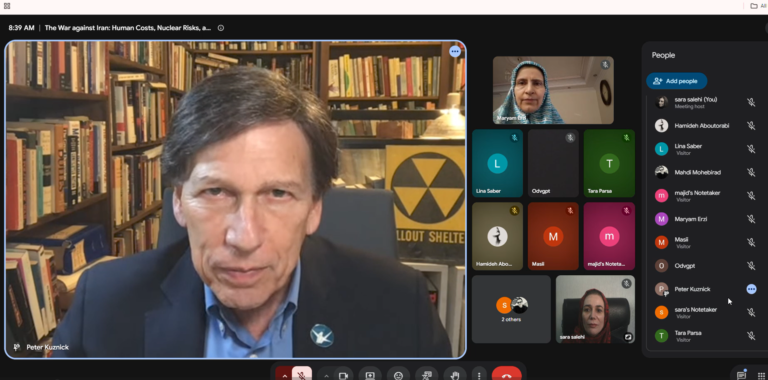
The Organization for Defending Victims of Violence (ODVV) held an online expert discussion on Tuesday, 24 November 2026, titled “The War against Iran: Human Costs, Nuclear Risks, and the Path to Peace,” with Professor Peter Kuznick, Professor of History and Director of the Nuclear Studies Institute at American University in Washington, D.C.
Kuznick is a scholar of nuclear history, U.S. foreign policy and the Cold War, and co-author with Oliver Stone of the book and documentary series The Untold History of the United States. The discussion examined the justifications advanced for the war against Iran, its human consequences and nuclear risks, Iran’s right to a civilian nuclear programme, demands for reparations and reconstruction, and prospects for peaceful solutions.
This report summarizes the principal views expressed by Professor Kuznick during the interview. The views expressed are those of the interviewee and do not necessarily reflect the official position of the Organization for Defending Victims of Violence.
Condemning the War against Iran and Attacks during Negotiations
Professor Kuznick began by describing the U.S.–Israeli war against Iran as illegal and immoral. He stated that Iran had been attacked twice while it believed that good-faith negotiations were under way. In his assessment of the confrontation, he argued that Iran held the upper hand and that the United States and Israel had limited options for pressuring Iran into accepting terms that Donald Trump and Benjamin Netanyahu could present as a victory. Kuznick later emphasized that, despite their military power, the two countries could not defeat Iran on the battlefield and that other ways of resolving disputes needed to be pursued.
The JCPOA and Iran’s Right to a Civilian Nuclear Programme
Challenging the justification that the attacks were intended to prevent Iran from acquiring nuclear weapons, Kuznick stated that Iran was not developing such a weapon. He recalled that Iran had been complying with the Joint Comprehensive Plan of Action (JCPOA) and had accepted extensive restrictions on its nuclear activities under the agreement.
He strongly criticized Trump’s withdrawal from the agreement in 2018, arguing that the deal Trump had abandoned was the very agreement that could have represented the best outcome of the nuclear negotiations he sought. Kuznick also referred to Ayatollah Khamenei’s fatwa against nuclear weapons.
He emphasized that Iran, as a party to the Nuclear Non-Proliferation Treaty, had the right to maintain a civilian nuclear programme. At the same time, referring to Iran’s subsequent increase in uranium enrichment to 60 per cent following the U.S. withdrawal, he said that he had disagreed with that step and had not considered it necessary. His position in this part of the discussion combined support for Iran’s right to a civilian nuclear programme with opposition to any move towards developing nuclear weapons.
Warning of the Risk of Nuclear Escalation
A substantial part of Kuznick’s remarks concerned the possibility of the United States or Israel using nuclear weapons against Iran. He explained that the experience of external attacks could lead some people in Iran to conclude that nuclear weapons were necessary for deterrence. However, he stressed that moving in that direction could expose Iran to a serious risk of nuclear attack.
Drawing on his academic work on Hiroshima and Nagasaki, Kuznick reiterated his opposition to any further use of nuclear weapons and called for their abolition. He warned that even limited nuclear use could trigger a chain of attacks and responses that might become impossible to control.
He welcomed the reaffirmation that Iran’s official policy remained one of not developing nuclear weapons and urged Iran to reiterate that policy clearly and publicly. In his view, doing so could help counter U.S. and Israeli pretexts for escalating the war. His remarks in this section were a warning about a possible scenario, rather than a statement that a decision to launch a nuclear attack had been made.
Threats to Civilians and Essential Regional Infrastructure
Kuznick warned about the consequences of extending attacks to nuclear facilities and water infrastructure. Referring to the Bushehr nuclear power plant, the Dimona nuclear complex and the region’s desalination facilities, he said that damage to such infrastructure could threaten people’s lives well beyond the borders of a single country.
He also argued that arms races diverted resources from people’s basic needs, emphasizing that those resources should instead support housing, education, healthcare and food programmes. Kuznick directed this criticism at various countries, including Iran, Israel and the United States, and called for militarization to be replaced by cooperation aimed at improving living conditions.
Criticizing the Use of False Claims to Justify American Wars
Asked about the tendency to describe past American wars as “mistakes,” Kuznick argued that this term did not adequately convey their nature. He said that the United States had been led into successive wars through lies, particularly since the Second World War. He cited Vietnam, claims about weapons of mass destruction in Iraq, and the nuclear justification advanced for the war against Iran.
He also criticized “American exceptionalism”: the belief that the United States is more moral and benevolent than other countries and, unlike other powers, acts solely to spread freedom and democracy. Kuznick argued that this image was inconsistent with the record of American wars.
U.S. Public Opposition and the Possibility of Restricting War Funding
Kuznick highlighted widespread opposition to the war against Iran among young Americans, describing it as a potential source of stronger political pressure against its continuation. He identified the possibility of Congress cutting off war funding as a source of hope and emphasized the importance of pursuing that opportunity.
Responding to a question about prospects for a peaceful solution after attacks during negotiations, he pointed to domestic pressures and opposition to continued war within the United States. However, he made clear that these pressures were insufficient to provide confidence that further escalation would be prevented and should not be treated as a guarantee that the war would end.
Demands for Reparations, Sanctions Relief and Reconstruction
Asked about repairing the harm suffered by Iranian families, Kuznick said: “I think the Iranians should demand reparations.” He stated that the United States should end sanctions, release Iran’s frozen assets, pay reparations and contribute to reconstruction, at least financially. He also called for U.S. withdrawal from the region and an end to regional wars.
Kuznick regarded these demands as justified but expressed doubt that they would all be fulfilled. He returned to the unrealized economic benefits of the JCPOA, saying that the Iranian people had not received the benefits they had been promised. Criticizing Europe’s failure to deliver on its promises and U.S. pressure under Trump, he reiterated his call for substantial reparations from the United States.
Diplomacy, Disarmament and Regional Cooperation
Discussing security guarantees, Kuznick argued that written agreements alone could not provide an absolute guarantee against war. In his view, lasting peace required peaceful cooperation to become a shared interest among countries in the region. He called for a programme of regional development and improved living standards that would include Iran and other regional parties, while also allowing for possible future cooperation with Israel. He envisaged a leading role for Iran in advancing peaceful cooperation and development.
Referring to the Reykjavik negotiations between Ronald Reagan and Mikhail Gorbachev, Kuznick also discussed a missed opportunity for nuclear disarmament and called for a renewed effort to eliminate nuclear weapons. He emphasized the role of young people, public opinion and religious leaders in strengthening demands for an end to war.
At the conclusion of the interview, Professor Kuznick expressed appreciation for ODVV’s work and emphasized the importance of protecting human rights, ensuring that people’s voices are heard, and advancing peace.