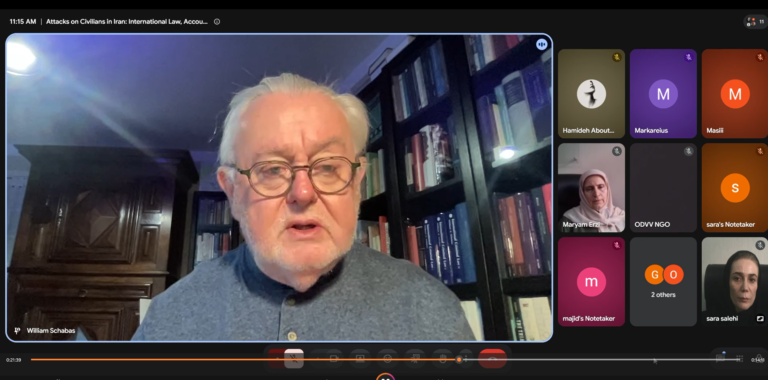
The Organization for Defending Victims of Violence (ODVV), a Tehran-based human rights NGO with Special Consultative Status with the United Nations Economic and Social Council (ECOSOC), held an online interview with Professor William A. Schabas on 23 November 2026, titled “Attacks on Civilians in Iran: International Law, Accountability and Reparations.”
Professor Schabas is Professor of International Law at Middlesex University London and a prominent scholar of international criminal law, genocide, and human rights. His professional experience includes serving as the initial Chair of the United Nations Commission of Inquiry into the 2014 Gaza conflict, membership of the Sierra Leone Truth and Reconciliation Commission, and involvement in proceedings before international courts and tribunals. The interview addressed the attacks on the Minab school and the Lamerd sports complex, the right to life, possible avenues for international criminal accountability, and the responsibilities of states to provide justice and reparations to civilian victims.
This report summarizes the principal observations and legal assessments shared by Professor Schabas during the interview. The views expressed are those of the interviewee and do not necessarily reflect the official position of the Organization for Defending Victims of Violence.
International Humanitarian Law, Aggression and the Right to Life
Addressing the US strikes on the Minab school and the Lamerd sports complex, Professor Schabas began by examining the limitations of international humanitarian law in protecting civilians during armed conflict. He explained that international humanitarian law does not automatically prohibit every attack resulting in civilian casualties, provided that the attack is directed at a legitimate military objective and the applicable legal requirements are respected. In practice, he observed, determining the actual purpose of an attack can be extremely difficult, particularly when the attacking state maintains that civilian deaths were unintended consequences of military operations.
Drawing a comparison with the conflict in Gaza, Schabas referred to Israeli attacks on residential buildings, universities, hospitals, and other civilian facilities. He noted that assertions of military necessity often make it challenging to establish whether an attack was genuinely directed at a military target or intentionally targeted civilians.
However, he emphasized that the legal assessment of attacks on Iran must go beyond the rules governing the conduct of hostilities. In his assessment, the military attacks carried out by the United States and Israel against Iran constituted aggression. He argued that violations of the right to life arising from an aggressive war could not be justified simply by invoking the rules of international humanitarian law.
Referring to the UN Human Rights Committee’s General Comment No. 36 on the right to life, Schabas explained that the deprivation of life resulting from a war of aggression raises human rights concerns affecting civilians and military personnel alike. He maintained that the starting point for examining the attacks should be the unlawfulness of the military action itself under international law and the United Nations Charter.
Precautionary Obligations and the Attacks on Minab and Lamerd
Turning to the question of precautions before military attacks, Schabas acknowledged the difficulties involved in establishing violations of the duty to verify targets and exercise adequate care in military operations. He referred to reports suggesting the use of artificial intelligence in target selection and possible shortcomings in the verification of intelligence. In his view, judicial examination of the degree of diligence required when selecting military targets could be particularly important.
Schabas cautioned that an attacking state may claim that it believed a target was lawful and that civilian deaths were unintended. Establishing the contrary, he explained, could require substantial evidence. He also made clear that he was not sufficiently familiar with the detailed circumstances of the Minab and Lamerd incidents to offer a definitive factual assessment of each attack. Nevertheless, he maintained that the broader legal assessment could not be separated from what he described as the unlawful use of force against Iran and its consequences for the right to life.
ICC Jurisdiction and Concerns over Double Standards
A substantial part of the interview focused on the difficulties of pursuing individual criminal responsibility for alleged war crimes against Iranian civilians. Professor Schabas explained that although Iran signed the Rome Statute, it has not ratified the treaty and is therefore not a State Party to the International Criminal Court (ICC).
He noted, however, that a state may accept the Court’s jurisdiction over crimes committed on its territory without becoming a party to the Statute. Such an acceptance could, subject to the Court’s legal and temporal jurisdictional requirements, also cover past events. Schabas observed that Iran might have concerns about taking this step because accepting the Court’s jurisdiction would not be limited to alleged offences committed by foreign forces. It could also expose the conduct of Iranian nationals to judicial scrutiny.
He linked these concerns to what he described as double standards in international institutions. Referring to resolutions concerning the 2026 conflict, he criticized the condemnation of Iranian attacks on regional states without comparable condemnation of the United States and Israel for their attacks on Iran.
He characterized this unequal approach as a particularly serious example of double standards and suggested that Iran might reasonably be concerned about similar selectivity in future decisions on whom to prosecute. Despite these concerns, Schabas considered acceptance of ICC jurisdiction the most logical legal option available to Iran. He also discussed possible proceedings before Iranian courts and the exercise of universal jurisdiction by national courts in other countries. However, he emphasized that these possibilities face significant practical obstacles, especially the difficulty of obtaining custody of suspected perpetrators.
Possible Criminal Responsibility of Senior US Officials
Professor Schabas further addressed the potential for proceedings involving senior American officials. He suggested that, if Iran accepted the Court’s jurisdiction and the applicable legal conditions were met, the ICC Prosecutor could in principle examine the responsibility of individuals involved in the attacks, including senior US officials.
In this context, he specifically referred to Donald Trump and Pete Hegseth, discussing questions of jurisdiction, immunity, and possible criminal proceedings. His remarks concerned hypothetical legal possibilities rather than any existing ICC charges or arrest warrants against those individuals in relation to the attacks on Iran.
Schabas also noted that Iranian domestic courts could, in principle, pursue individuals suspected of committing war crimes on Iranian territory, although arresting and securing the presence of such individuals would present substantial difficulties. More broadly, he criticized the attitude of major powers towards international criminal justice, arguing that some powerful governments behave as though international legal rules do not apply to them.
State Responsibility and Reparations for Victims
Responding to a question about the obligations of the United States towards victims of the Minab and Lamerd attacks, Professor Schabas distinguished between established legal principles and the practical difficulties of enforcing them. He expressed the view that the United States had presumably committed war crimes in Iran and would be under an obligation to provide compensation and other forms of reparation to victims.
He explained that an international court with appropriate jurisdiction could, in principle, order such remedies. Schabas referred to the International Court of Justice’s judgment of 19 November 2026 in The Gambia v. Myanmar, in which the Court found Myanmar responsible for genocide against the Rohingya and ordered measures of restitution and compensation, with the amount and modalities of compensation to be addressed in a subsequent phase.
He considered this judgment relevant to the broader principle of state responsibility for serious violations of international law. However, he emphasized that bringing the US government before an international judicial body with jurisdiction would be exceptionally difficult. In his assessment, American military power, economic influence, and the reluctance of many states to challenge Washington significantly restrict the prospects for accountability in the near future.
At the same time, he cautioned against assuming that justice would remain permanently unattainable. Drawing on historical examples of delayed acknowledgment and reparations, he suggested that the passage of time does not necessarily eliminate claims for justice.
The Importance of Independent Human Rights Documentation
Turning to the practical role of human rights organizations, Schabas placed particular emphasis on rigorous and independent documentation. He explained that credible records of violations are essential to prevent future distortions of events and to preserve the possibility of legal accountability. Referring again to the recent ICJ judgment concerning Myanmar, he noted the importance attached to reports prepared by United Nations fact-finding mechanisms and human rights organizations.
According to Schabas, the credibility of such evidence depends heavily on the independence of investigations, the quality of their methodology, and the ability of others to verify the findings. He encouraged human rights organizations to document alleged violations as comprehensively as possible and to ensure that the resulting records are publicly accessible and verifiable. Although immediate justice may be unlikely, he stressed that reliable documentation can remain valuable for future proceedings.
Enforcement Challenges and the Limits of International Criminal Justice
During the follow-up discussion, an ODVV representative raised concerns about the limited enforcement of international judicial decisions and questioned whether victims of attacks such as those in Minab and Lamerd could realistically expect justice. In response, Professor Schabas referred to the arrest warrants issued by the ICC for Benjamin Netanyahu and other officials. He argued that even where an accused person has not been arrested, such warrants may have practical consequences, including restrictions on international travel.
He explained that a central weakness of international criminal justice is its dependence on states to arrest suspects and transfer them into custody. Without the accused being present, the ICC cannot proceed to trial. Schabas acknowledged that the international legal system remains incomplete and that enforcement against influential political leaders is particularly difficult.
Nevertheless, he rejected the idea that international criminal justice has no practical effect. In his view, the system has developed significantly over the past century, although it still falls far short of the enforcement capacity generally associated with domestic legal systems. He also criticized the political constraints affecting the United Nations Security Council. Referring to the US veto, he argued that condemning the United States through the Council is effectively impossible, reflecting broader inequalities in the international system.
At the conclusion of the interview, Professor Schabas expressed sympathy, warmth, and friendship towards the Iranian people and acknowledged the suffering they have experienced as a result of what he described as the war of aggression waged by Israel and the United States. He also expressed his hope that his observations would be useful to ODVV’s human rights work.