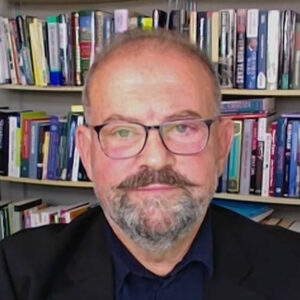
In an exclusive interview with the Organization for Defending Victims of Violence, Robert Fantina strongly condemns Israel’s 2025 attacks on Iran as clear violations of Article 2(4) of the UN Charter, rejecting Israel and the U.S.’s misuse of Article 51 for justification. He highlights the deliberate targeting of civilian infrastructure as part of a broader strategy of intimidation and oppression, rooted in settler-colonialism and systemic injustice. Fantina calls for global civil society to intensify solidarity and activism to hold perpetrators accountable and expose the intertwining of power, propaganda, and impunity that sustains these crimes.
In mid-June 2025, Israel—with full logistical, military, and intelligence backing from the United States—launched a twelve-day aerial operation against Iran, ostensibly targeting military sites. However, the strikes also hit vital civilian infrastructure, including hospitals, water and energy systems, pharmaceutical facilities, and Red Crescent ambulances, in Tehran and several other cities. Hospitals, water systems, ambulances, pharmaceutical plants, residential towers, and media offices were all struck in a campaign widely condemned as a flagrant breach of international law. The toll: over 1,100 civilian deaths, including 132 women and 47 children, and more than 5,700 injuries.
The international legal and humanitarian implications of such violence—compounded by the persistent silence or complicity of Western powers—raise urgent questions about the enforcement of global norms and the accountability of dominant actors. To engage with these questions, the Organization for Defending Victims of Violence (ODVV) held an exclusive interview with Robert Fantina, a committed voice for global justice and a long-standing critic of militarism, propaganda, and Western double standards.
Robert Fantina is a journalist and activist who currently serves on the boards of Canadian Voices for Palestinian Rights and Canadians for Justice in Kashmir, and writes regularly for CounterPunch, Global Research, and other platforms. His books include “Occupied Palestine: Israel, the U.S. and International Law”, “Empire, Racism and Genocide: A History of U.S. Foreign Policy”, and “Propaganda, Lies and False Flags: How the U.S. Justifies Its Wars”. Through both his journalism and activism, Mr. Fantina advocates for an international order grounded in law, dignity, and truth.
Below is the full text of the interview for your consideration:
1. In light of Israel’s military attacks on Iran since 13 June 2025—which have resulted in over 1,100 civilian deaths, including 126 women and 41 children, and more than 5,700 injuries—how do you assess the legality of these actions under international law, particularly Article 2(4) of the UN Charter? What is your view on Israel and the U.S. invoking Article 51 to justify these strikes?
The attack on Iran clearly violated Article 2(4) of the UN Charter, which forbids the use of force against any sovereign nation. Israel and the U.S. consider themselves above the law, as has been demonstrated repeatedly for decades. They attacked Iran – a sovereign nation – that posed no threat to them.
Article 51 does not come into play in this situation in terms of Israel and the United States. That article describes the rights of self-defense in the event of an armed attack. So while the Iranian government was justified in retaliating, based on the rights enshrined in Article 51, the U.S. and Israel were not.
The United States will use any excuse and justification – valid or not, and usually not – to attack any nation it sees as an ‘enemy’. Iran hasn’t demonstrated any threat to the U.S. or Israel, although both those nations have threatened, and now attacked, Iran.
2. The targeting of civilian infrastructure—including hospitals, water systems, ambulances, and a pharmaceutical facility—has led to mass displacement in Tehran. What strategic goals do you believe Israel was pursuing, and how do such tactics reflect broader trends in its military doctrine?
The Israel government and its chief sponsor, the United States, have no interest in human rights or international law. The U.S. launched its so-called ‘war on terrorism’ decades ago, but from the start it has been a war of terrorism, not on terrorism. Israel and the U.S. do not only seek military victory over Iran, the same way they are seeking far more in Palestine. They want to intimidate the residents of those countries to the point that they will be willing to submit to whatever cruelties and indignities Israel and the U.S. choose to inflict, and history shows that those cruelties and indignities have no limits. The U.S. and Israel refuse to learn that the people of Palestine, Iran, Lebanon, Syria and Yemen will not be defeated.
3. The assassination of 13 Iranian civilian scientists and their families, along with Red Crescent medical personnel, has been widely condemned as extrajudicial killings. What role can international mechanisms such as the ICC or the UN Human Rights Council play in addressing such violations?
Government leaders in Israel and the U.S. and the soldiers who do their bidding, must be held accountable. The UN Human Rights Council is mainly a monitoring and recommending body, but its recommendations can be used by the International Criminal Court to hold international criminals accountable. The U.S. government continues to do all that it can to restrict the ICC, but that body continues its work regardless of the impediments created by the U.S. Additionally, the International Court of Justice must be more pro-active in issuing warrants for U.S. and Israel government leaders who were involved in the attacks on Iran.
4. Given your academic work on settler colonialism and the dehumanization of racialized populations, how do you interpret the ongoing Israeli violence in Palestine through this lens? What patterns of state domination and systemic injustice do you see emerging from the occupation and blockade?
What is happening today in Palestine – both the Gaza Strip and the West Bank – is settler-colonialism at its most brutal manifestation. Genocide can be seen as the ultimate step in settler-colonialism. We are seeing desperate people being starved and then offered some limited food, and when they seek to obtain that food, they are mercilessly shot and killed. A dear friend of mine died this way just last week. The Israel and U.S. governments are purposely arranging these atrocities: first, by preventing any food from entering the Gaza Strip for several months causing severe hunger; second, by establishing a ‘food distribution’ program that is limited and selective, and that has been condemned by all reputable human-rights organization in the world; third, once these desperate, starving people hear of a ‘food distribution’ sight opening in their proximity, the flock to it and, as they approach, they are shot to death. It is difficult to imagine a more premediated or brutal cruelty.
5. You have written extensively on the manipulation of narratives in Western media and politics. Why do you think so many Western policymakers continue to support Israel despite decades of documented human rights violations and international condemnation? What does this reveal about the interplay between power, propaganda, and legal accountability?
The U.S. is, of course, Israel’s main sponsor and the reason it commits war crimes and crimes against humanity with impunity. In the U.S., lobby groups donate large sums of money to candidates for elective office. One of the most powerful of these lobby groups is the combined pro-Israel lobbies. These organizations donate tens of millions of dollars to the election and re-election campaigns of U.S. officials who will do their bidding. These officials are anxious to retain their positions of power and prestige, and therefore accept the ‘donations’ and then, when in office, introduce legislation that is written by the lobbyists. Human rights and international law are a distant second on their priority lists, if they appear on those lists at all.
So here we see a clear interplay between power – the desire for elected officials to maintain their positions at any costs; propaganda – the legislation introduced, written by pro-Israel lobbyists that focus on their Zionist views while ignoring international law and human rights, and legal accountability which is swept aside to allow the campaign donations to continue to flow.
6. As an analyst of social movements, what forms of civil society resistance and international solidarity do you believe are most effective today in countering Israeli state violence and impunity—particularly in the context of Palestine, Iran, and the broader Global South?
It was reported today that an Israeli cruise ship was prevented from docking at a scheduled port in Greece because of peaceful pro-Palestinian protesters. Ships arriving on the west coast of the United States delivering goods from Israel have been delayed in being unloaded because of protests there. University encampments and other forms of protest around the world caught the attention of academic leaders, some of whom simply threatened or punished the protesters, but some of whom listened to them and made changes. Unions and religious organizations have voted to divest from Israeli investments. The boycott, divest and sanction movement continues to grow.
As the global reputation of Israel continues to degrade due to its ongoing genocide, its actions against other countries, including Iran, Lebanon, Syria and Yemen must be associated with that genocide. They are all part of the same violent, illegal methods that are common for both Israel and the United States.
People globally must demand adherence to international law by their leaders. People in countries that have any semblance of fair voting procedures must assure that the officials they elect will stand for human rights and international law, and are committed to prosecuting those that violate them.
7. Finally, what steps can independent scholars, journalists, and human rights advocates take to document, expose, and challenge the normalization of aggression and double standards in international legal enforcement—especially regarding Israel?
We must continue to document the atrocities, and work to assure that the side of justice is heard. This is not always the case, especially in the context of Palestine and Israel. A recent study by Enouri, et al. is instructive. In comparing “…221 articles published between October 7, 2023, to October 7, 2024, they found that ‘Pro-Gaza stances represented two-thirds of the reviewed papers. Pro-Gaza papers were published in more impacted journals and exhibited better altmetrics. While pro-Gaza authors were affiliated with various international institutions, pro-Israel authors were mainly affiliated with Israeli Institutions’”. This indicates a high degree of credibility and international respect for pro-Palestine journalists, far more than for those that support Israel. This kind of information must be made public. If scholarly papers supporting Palestine have far more credibility than those supporting Israel, the so-called mainstream media and current politicians must be made aware of this, and those politicians who continue to support Israel in order to obtain campaign contributions, must be removed from office.
Scholars and journalists who support Palestine must not cease speaking for justice, human rights and full compliance with international law.