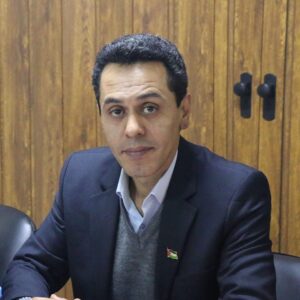
As part of its ongoing efforts to examine the humanitarian and legal dimensions of recent military aggression against Iran, the Organization for Defending Victims of Violence (ODVV) conducted an interview with Elijah J. Magnier, veteran war correspondent, military and political analyst, and specialist on Middle Eastern and international affairs.
Magnier is widely known for his long-standing coverage and analysis of conflicts and political developments across the Middle East, including Palestine, Lebanon, Syria, Iraq, Yemen, and Iran. Through his reporting and geopolitical analysis, he has extensively addressed issues related to regional security, armed conflict, foreign intervention, and the humanitarian consequences of war.
In this interview, Magnier discusses the growing normalization of large-scale military force against civilian environments, the erosion of legal protections for civilian infrastructure, and the limitations of international accountability mechanisms in contemporary warfare. He also reflects on the political paralysis of international institutions and the broader implications of impunity for war crimes and crimes against humanity.
The views expressed in this interview do not necessarily reflect the official positions of the Organization for Defending Victims of Violence.
The full transcript of the interview follows:
1. When you reflect on the recent attacks by the United States and Israel on Iran, what is the most striking or shocking aspect of this new escalation for you? How do you see this situation in continuity with experiences of war in Palestine and other parts of the region?
The most striking aspect is the apparent normalization of unlawful large-scale force as a political instrument, even when negotiations are still possible or already underway. From a humanitarian and legal perspective, this places the situation in direct continuity with Palestine, Iraq, Lebanon, and Yemen, where civilian life has repeatedly been treated as an acceptable cost of strategic messaging. The central issue is not only the number of bombs dropped, but the erosion of the legal distinction between military objectives and the civilian environment that sustains society.
2. In Iran, during these attacks, not only military targets were affected. Schools and hospitals, as well as bridges, petrochemical facilities, airports, media centers, rescue helicopters, water infrastructure, and even residential areas have been targeted. Alongside this, scientists and children have also been among the victims. In such a context, what does this wide range of destruction indicate about the military conduct of the United States and Israel toward Iran, and previously toward the people of Gaza?
When schools, hospitals, bridges, airports, media centers, rescue helicopters, water infrastructure, petrochemical facilities and residential areas are struck, this points to a method of unlawful warfare that exceeds lawful military necessity and enters the terrain of collective punishment, intimidation and systemic destruction. International humanitarian law requires distinction between civilians and combatants, and between civilian objects and military objectives; it also prohibits indiscriminate attacks and attacks expected to cause excessive civilian harm in relation to the concrete military advantage anticipated. The same legal concern has been central in Gaza, Iran and Lebanon: the battlefield is expanded until civilian infrastructure itself becomes part of the pressure strategy.
3. In the recent escalation, around 3,700 people were killed and many civilian infrastructures in Iran—including medical, educational, industrial, and petrochemical facilities—were severely damaged, all of which were non-military targets. What can be done to ensure that existing international human rights and humanitarian law prohibiting harm to civilians and civilian infrastructure is respected? Is there any mechanism to address the deliberate disregard of these rules by attacking states?
Existing law is clear, but enforcement is weak. Attacks intentionally directed against civilians or civilian objects constitute war crimes under the Rome Statute, and the duty to take constant care to spare civilians and civilian objects is a core rule of customary IHL. Mechanisms exist, should be used but are slow and powerless in several cases: UN investigations, fact-finding missions, International Criminal Court referrals or investigations where jurisdiction permits, universal jurisdiction cases in national courts, sanctions against commanders and political leaders, and state responsibility claims. The difficulty is not the absence of law, but the political protection enjoyed by powerful states and their allies.
4. Given the U.S. and Israeli attacks on Iran, carried out during ongoing negotiations between the United States and Iran, and the fact that international organizations have not responded effectively despite damage to civilians and civilian infrastructure, why do you think these institutions perform so weakly during times of war? What simple steps could improve their effectiveness?
International institutions perform weakly in wartime because law is filtered through power. The UN Security Council is often paralyzed by vetoes or alliances, while humanitarian agencies may document violations but lack enforcement power. A few practical improvements would matter: automatic independent investigations after major attacks on civilian infrastructure, mandatory public legal justifications by attacking states, stronger protection for medical and rescue services, faster preservation of evidence, greater use of national courts under universal jurisdiction and a narrative campaign to expose the crimes against humanity and war crimes. Without consequences, the rules remain formally intact but politically hollow.