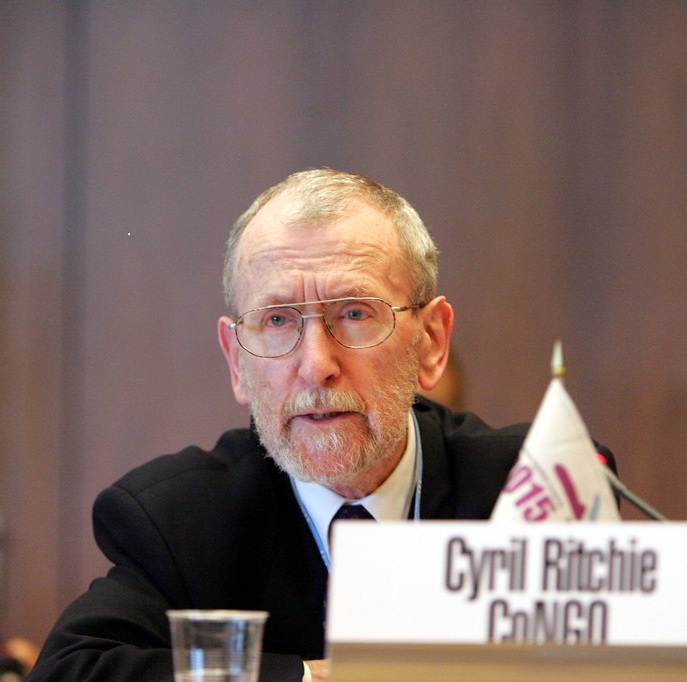
Exclusive interview with Mr. Cyril Ritchie, First Vice President of CoNGO in Consultative Relationship with the United Nations (CoNGO) by the ODVV
As a member of the Conference of Non-Governmental Organizations in Consultative Relationship with the United Nations (CoNGO), and in line with our commitment to raising awareness about the missions and activities of leading international networks, the Organization for Defending Victims of Violence (ODVV) conducted an exclusive interview with the First Vice President of CoNGO, Mr. Cyril Ritchie.
This in-depth conversation seeks to inform civil society actors, human rights defenders, and the broader public about the vital role CoNGO plays in amplifying the voices of NGOs within the United Nations system.
In this interview, we delve into a broad range of topics: CoNGO’s collaborative engagement with its members; its most significant achievements in influencing global policy; its principled stance and advocacy in times of crisis; the mechanisms it employs to defend fundamental rights; its evolving role in an era of geopolitical challenges; and its strategies for ensuring that marginalized voices, such as those of refugees, women, and indigenous communities, are meaningfully heard. We also examine how CoNGO is adapting to the digital era to enhance inclusivity, transparency, and participation across diverse regions.
Through this dialogue, readers will gain a clearer understanding of CoNGO’s strategic priorities, its continuing relevance in the multilateral arena, and the opportunities available for organizations worldwide to contribute to and benefit from its mission of strengthening the role of NGOs within the UN ecosystem.
Below is the full interview:
1. To begin, for the benefit of civil society actors, human rights defenders, and the wider public, could you briefly introduce CoNGO and explain its mission, structure, and the scope of its influence within the UN system?
To promote and defend the voice of civil society at the United Nations. To ensure that NGOs in consultative or equivalent relationship with any part of the United Nations System enjoy the fullest opportunities and all appropriate facilities for performing their consultative functions. To foster cooperation and dialogue among all NGOs and with groupings of NGOs related to the Unted Nations System. To provide a forum for the exchange of views on matters relating to the consultative process, and on strengthening the relationship between NGOs and the United Nations, including the contributions which NGOs can make to promoting the principles, purposes and effectiveness of the United Nations and its related agencies and programmes. To mobilize public opinion in support of the aims and principles of the United Nations and to promote education about the UN with special emphasis on the contribution which NGO make to its work. To convene meetings of NGOs for the exchange of views on matters of common interest.
CoNGO has a General Assembly (meeting at three-to-four year intervals); a President and Governing Board elected by the Assembly; Officers elected by the Board; 30+ Substantive Committees, primarily based in Geneva, New York and Vienna, which promote and facilitate collective work among NGOs on the substantive issues related to programmes, policies and activities of the United Nations System. They organize activities which provide opportunities for NGOs to debate such issues, to articulate their views, to advocate positions with respect to UN resolutions or programmes, and to mobilize public opinion. CoNGO has offices in Geneva and New York, and a presence in Vienna.
2. How has CoNGO engaged with its member NGOs in recent years? Can you highlight some key collaborative initiatives or joint advocacy efforts, and what outcomes or impacts have resulted from these engagements?
The CoNGO website (www.ngocongo.org) is a major channel for information to and from members, and from CoNGO Substantive Committees. It includes the list of all members, an extensive calendar of UN and NGO events, contact points for Substantive Committees, references to recent CoNGO and member initiatives, and the Membership Application form.
CoNGO joins with member organizations in specific initiatives, for example statements on the occasion of UN International Days or certain UN Conferences. CoNGO relays these statements to the UN and to civil society worldwide.
Moreover CoNGO has in recent years held two Summits, one in October 2021 on Substantive Issues; and one in June 2025 on NGO Committees that interact with the UN These have been attended by a large number of members, critically examining and advancing policies and concerns that are common both to the UN and civil society. During CoNGO’s 75th Anniversary in 2023 similarly large events were held (four Commemorations in Bangkok, Geneva, New York and Vienna; and six Webinars spread throughout the year, one of which had over 1,000 participants), to explore advancing issues and values shared with the United Nations System.
3. What are some of CoNGO’s most significant achievements in terms of influencing global policy, amplifying civil society voices, or shaping UN-level discourse? Could you provide concrete examples of where CoNGO’s work has had a visible impact on international decision-making?
CoNGO influencing global policy and shaping UN-level discourse: The CoNGO President and First Vice President – as well as many leaders of CoNGO Substantive Committees – intervene regularly at UN and NGO Conferences, in UN Committee meetings, Working Groups, expert panels, etc.
- to advocate for policies and decisions in conformity with CoNGO’s mission as described in point 1 above;
- to ensure that intergovernmental mechanisms are aware of the importance of taking into account the specialized regional and grass-roots knowledge that civil society brings to the table;
- to remind governments that they are accountable to their populations and have the obligation to implement the UN Conventions and Declarations that they have themselves adopted.
This is long-haul work, often bringing results below the surface, and is based on CoNGO’s decades-long accumulated experience of the functioning (and sometimes non-functioning) of multilateralism.
CoNGO Officers and Substantive Committee leaders also maintain regular contacts with relevant UN System staff at multiple levels, not least in the advance stages of Secretariat preparations for UN Summits, Conferences, and other decision-making forums.
4. Given the current global challenges, how has CoNGO responded to crises such as the situation in Gaza? Has the organization undertaken or supported any initiatives related to this? If so, what has been the impact, and are there ongoing plans for multilateral collaboration in this regard?
As a conference/confederation/community of over 500 organizations, CoNGO does not speak for its members on specific national crises. But it constantly advocates internationally for the upholding of the values, purposes, and principles set out in the UN Charter (peace, security, justice, non-aggression, human rights, equality, development…) and of the standards established by UN Conventions and International Law, including, of course, Humanitarian, Refugee and Environmental Law.
5. What tools, mechanisms, or strategic levers does CoNGO use to help fulfill its mandate of promoting civil society participation and defending fundamental rights at the international level?
CoNGO mechanisms in promoting civil society participation and defending fundamental rights: All the above paragraphs provide examples.
6. How do you envision CoNGO’s role evolving in the coming years, particularly in the context of increasing global polarization and multilateral challenges? What strategies are being considered to enhance the influence of CoNGO and its members in international decision-making forums?
CoNGO is unique in that it deals with, and promotes strong ongoing collaborative relationship with, the entire 50+ entities that compose the United Nations System. The next CoNGO General Assembly will discuss ways to strengthen CoNGO’s ability (finance, human resources, communications, technology) to fulfill its mission.
CoNGO is deeply distressed at the inadequate, delayed or conditional funding of the United Nations by its Member States, and at the increasing attempts to dismantle critical multilateral processes and mechanisms. It will continue to raise these issues in its interventions in international decision-making forums.
7. In your view, what is the unique value that CoNGO provides to grassroots organizations and national NGOs, especially those based in the Global South? How can such organizations better engage with and benefit from CoNGO’s work?
It is recalled that to be a Full Member of CoNGO, an NGO – with no distinction between international and national – must have Consultative Status with UN.ECOSOC. (Associate Members must have a consultative link or equivalent status with another entity of the UN System.)
Recently there has been a distinct increase in CoNGO membership of NGOs based in the Global South, and their voices are therefore increasingly heard in CoNGO bodies and forums. Such NGOs could increasingly use and benefit from CoNGO’s “Compendium of Principles for NGO Good Practice” whose four chapters cover Independence of NGOs; Independence vis-à-vis the United Nations; Cooperation among NGOs; Personal responsibility and standards. The next CoNGO General Assembly will consider expanding the Compendium.
CoNGO also strives to encourage greater participation from the Global South by increasingly organizing both in-person and on-line hybrid meetings to enable as many organizations as possible to be engaged.
8. As digital transformation reshapes advocacy and human rights work globally, how is CoNGO adapting to the digital era, particularly in terms of virtual engagement, inclusivity, and transparency across diverse regions and stakeholder groups?
This will be a topic at the next CoNGO General Assembly. Discussions are under way to give shape to CoNGO’s future needs and requirements, naturally in terms of inclusivity and transparency.
9. How does CoNGO ensure that the voices of marginalized groups, such as refugees, women, and indigenous peoples, are meaningfully represented and prioritized within UN mechanisms and broader civil society dialogues?
The CoNGO Officers and Substantive Committee interventions at UN events (referred to several times in the preceding paragraphs) frequently recall the importance of hearing the voices of people who are marginalized, side-lined, discriminated-against, or otherwise denied justice. Examples include women and girls, indigenous peoples, older persons, persons with disabilities, migrants…
10. Finally, how can individuals and organizations who are not yet affiliated with CoNGO become more involved, contribute to its initiatives, or support its mission of strengthening the role of NGOs within the UN ecosystem?
It is first relevant to recall (see paragraph 7 above) that CoNGO is statutorily a conference of organizations, not of individuals. (Of course, member organizations, once admitted, appoint individuals to represent their interests within relevant CoNGO bodies.) Furthermore, the statutory Full or Associate membership requirement for organizations is to have a consultative relationship or link with an entity of the UN System. Once that requirement is verified, CoNGO welcomes all membership applications.
In addition, as indicated in preceding paragraphs, CoNGO acknowledges a role to advance the values and broader causes that are embodied by civil society as a whole, and certain of its actions encourage and welcome wider civil society participation, if financial or technical constraints can be overcome.
Influencing the UN and its member governments to make the best decisions in the interest of people and the planet is everyone’s concern !
For further information, you can see: https://ngocongo.org/
Cyril Ritchie
CoNGO First Vice President
August 2025