Following the escalation of tensions and the launch of U.S. and Israeli military aggression against the Islamic Republic of Iran, Just World Educational, under the leadership of veteran journalist, researcher, and West Asia analyst Helena Cobban, launched a series of expert discussions entitled The Iran Crisis on February 25, 2026.
The series constitutes the second phase of the broader Gaza and the World project, which was initiated by Just World Educational in late 2025. The project aims to provide a platform for leading international experts to examine various dimensions of the ongoing crisis, including military developments, implications under international law, the geopolitical and geoeconomic consequences of the war, its impact on West Asia, and its connections to other regional crises.
As part of this initiative, discussions have been held with a number of prominent international scholars, analysts, and former officials, including Richard Falk, Ray McGovern, Chas Freeman, Trita Parsi, John Ross, Elijah Magnier, Maryam Jamshidi, and several other distinguished experts and commentators.
Recognizing the importance of the issues addressed in this series and the value of making these international perspectives accessible to Persian-speaking audiences, the Organization for Defending Victims of Violence (ODVV), through a bilateral cooperation agreement with Just World Educational, intends to translate and republish selected conversations from this project.
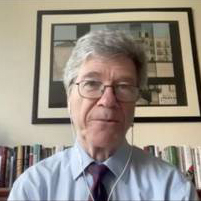
The twenty-fourth episode of the series features a conversation between Helena Cobban and Professor Jeffrey Sachs, the internationally renowned economist, university professor, and long-time advisor to the United Nations. In this discussion, Sachs examines the economic, political, legal, and international dimensions of the U.S.-Israeli war against Iran and assesses its implications for both the region and the wider world.
The main points raised during the conversation are summarized below.
At the outset of the discussion, Jeffrey Sachs emphasizes that the economic consequences of the war against Iran are already being felt across the globe. In his view, although it is still too early to determine the full scale of the damage caused by the crisis, the continuation of the war and any further escalation could generate far-reaching consequences for the global economy. He notes that the ultimate extent of the damage will depend largely on future decisions taken by the United States.
Sachs also discusses the response of global markets, particularly energy markets, explaining that current oil prices reflect the expectations of governments, corporations, and economic actors regarding the future of energy supply routes. According to him, existing market conditions indicate that some economic actors still expect supply flows to resume before a deeper crisis unfolds.
In another part of the conversation, Helena Cobban and Jeffrey Sachs examine the political roots of the crisis. Criticizing the policies pursued by Washington and Tel Aviv, Sachs argues that the war lacks any rational basis and describes it as the result of dangerous and irresponsible decision-making by U.S. and Israeli leaders. He contends that, rather than contributing to the resolution of conflicts, the United States has become one of the principal obstacles to peace and stability in the region.
He further argues that the primary beneficiaries of the war are a narrow group of vested interests, including oil companies and military contractors, while its economic and human costs are being borne by ordinary people in the United States and around the world.
Responding to a question regarding the impact of the crisis on countries of the Global South, Sachs warns that rising energy prices, food costs, and fertilizer shortages will place the greatest burden on poorer nations and vulnerable communities. He also raises concerns about worsening food insecurity in the coming months and stresses that climate-related factors, including the possibility of a severe El Niño event, could further exacerbate these challenges.
Another part of the discussion focuses on the role and performance of the United Nations. While defending the importance of the UN and several of its affiliated bodies, including the International Court of Justice (ICJ) and the United Nations Relief and Works Agency for Palestine Refugees in the Near East (UNRWA), Sachs argues that these institutions have been constrained by political pressure from major powers.
Criticizing the approach of the United States, he accuses Washington of disregarding international law, ignoring Security Council decisions, and undermining the UN system. In his view, the central problem lies not within the structure of the United Nations itself, but in the conduct of states that refuse to engage constructively with the international organization.
Sachs also refers to the proceedings before the International Court of Justice concerning Palestine. Criticizing delays in the implementation and follow-up of judicial decisions, he reiterates the principle that “justice delayed is justice denied.”
The final segment of the conversation turns to domestic politics in the United States. Sachs argues that a significant portion of the American public opposes the war and supports the establishment of a Palestinian state. At the same time, he maintains that political decision-making in the United States remains heavily influenced by the interests of particular groups.
In conclusion, Sachs stresses that the immediate priority should be ending the blockade, stopping the war, lifting sanctions, and preventing any further escalation of the crisis. From his perspective, the United States should disengage from the conflict and help create conditions conducive to de-escalation and the restoration of stability.