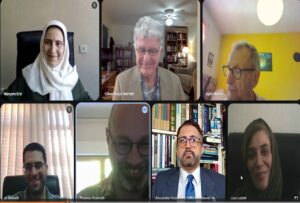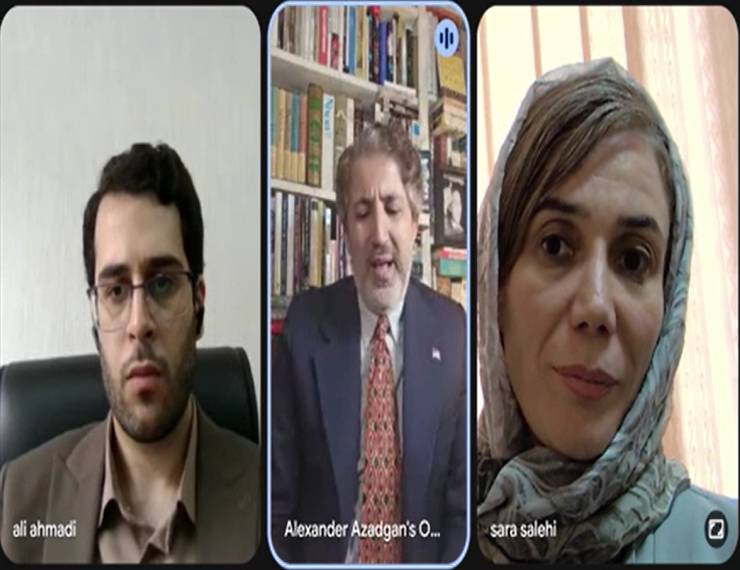
As part of its ongoing efforts to document and analyze the humanitarian, legal, and geopolitical consequences of recent military aggression against the Islamic Republic of Iran, the Organization for Defending Victims of Violence (ODVV) conducted an online interview with Professor Alexander Azadgan, an American academic, senior political commentator on global news channels, and Chief Geopolitical Counsel with the Center for Geostrategic Studies.
During the discussion, Professor Azadgan examined the strategic objectives behind attacks on civilian targets, the role of information warfare in shaping international perceptions of the conflict, and the importance of legal accountability for violations of international humanitarian law. He also reflected on Iran’s geopolitical significance, the challenges posed by contemporary media narratives, and the need for stronger diplomatic and legal efforts to defend civilian rights.
This report presents a summary of the key observations and insights shared by Professor Alexander Azadgan during a two-hour online interview with ODVV, focusing on the most significant legal, humanitarian, media, and geopolitical dimensions of recent developments.
The views expressed in this interview do not necessarily reflect the official positions of the Organization for Defending Victims of Violence.
Professor Azadgan argued that attacks on civilian infrastructure, particularly schools and children, should not be viewed merely as unintended consequences of military operations. In his assessment, such attacks form part of a broader strategy of psychological warfare designed to undermine the morale of a nation and weaken its capacity for resistance. Referring to incidents involving civilian casualties, including children, he emphasized that targeting vulnerable segments of society serves to inflict collective trauma, delay effective responses, and strike at the future of a nation. According to his analysis, similar methods have been employed in conflicts across Gaza, Lebanon, Syria, and Iraq, where civilian suffering has been used as a tool of pressure and intimidation.
A significant part of the discussion focused on the information dimension of contemporary warfare. Professor Azadgan maintained that modern conflicts are fought not only on battlefields but also through media narratives and psychological operations. He criticized the tendency of some Western political and media circles to frame conflicts in ways that obscure the realities of aggression and shift attention away from the suffering of affected populations. In his view, terminology and narrative framing play a critical role in shaping public understanding of conflicts and influencing international responses. He stressed that information warfare has become one of the most important components of modern geopolitical competition.
Professor Azadgan further argued that international audiences are often exposed to selective narratives that portray aggressors as defenders of order while depicting targeted states as the source of instability. He emphasized the importance of independent media platforms, alternative channels of communication, and public diplomacy efforts capable of challenging dominant narratives and presenting documented realities to global audiences.
Addressing the legal dimensions of the conflict, Professor Azadgan underscored the necessity of systematically documenting all civilian casualties, attacks on civilian infrastructure, and material destruction resulting from military operations. He argued that such documentation is essential for future legal proceedings before international judicial mechanisms, including international courts and tribunals. In his view, accountability requires meticulous evidence collection, preservation of records, and sustained legal advocacy at international forums. He also stressed the importance of pursuing compensation claims for damaged infrastructure and civilian losses through all available legal channels.
The discussion also examined broader geopolitical developments in the region. Professor Azadgan argued that Iran occupies a uniquely important position in emerging regional and international economic corridors and remains a key actor in shaping future geopolitical arrangements. He suggested that growing competition over trade routes, regional influence, and strategic connectivity forms part of the broader context within which current tensions should be understood.
According to Professor Azadgan, Iran’s geopolitical role has become increasingly significant in a changing international order characterized by the rise of new economic and political centers of power. He maintained that some external actors view Iran as an obstacle to broader regional restructuring projects and that this reality contributes to the strategic pressures directed against the country.
Professor Azadgan also highlighted the importance of internal resilience in confronting external threats. He emphasized that economic stability, institutional effectiveness, social cohesion, and efforts to address corruption are essential elements of national security. Strengthening public trust, creating opportunities for younger generations, and reducing conditions that contribute to emigration were identified as important factors in reinforcing a society’s capacity to withstand external pressure. Concluding his remarks, Professor Azadgan stressed that the protection of civilians and civilian infrastructure must remain at the center of international accountability efforts. He argued that effective responses to violations of international humanitarian law require a combination of legal action, public diplomacy, independent media engagement, and comprehensive documentation of the human and material consequences of armed conflict. The interview ultimately highlighted the interconnected nature of modern warfare, where military operations, psychological warfare, information campaigns, and geopolitical competition increasingly function as elements of a single strategic environment.