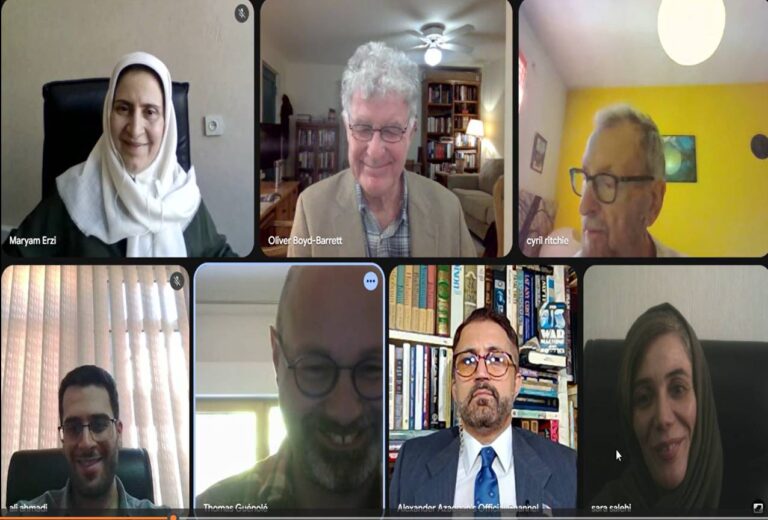
As part of its ongoing efforts to document grave violations of human rights and international humanitarian law resulting from the recent military aggression by the United States and Israel against Iran, the Organization for Defending Victims of Violence (ODVV) convened an in-depth international webinar on May 25, 2026. The event brought together prominent scholars, geopolitical analysts, media experts, and international civil society figures to examine the broader legal, political, humanitarian, and strategic implications of the ongoing escalation.
The webinar featured the participation of Oliver Boyd-Barrett, retired Professor of Media and Communication Studies; Alexander Azadgan, Professor of Business Studies and International Political Economy in Southern California; Thomas Gennolé, French political scientist, author, and international affairs analyst; and Cyril Ritchie, senior figure within the Conference of NGOs in Consultative Relationship with the United Nations (CoNGO).
Throughout the webinar, speakers strongly condemned the recent military attacks against Iran, particularly the targeting of civilian infrastructure, including schools, hospitals, media facilities, and public institutions. Participants emphasized that such attacks constitute serious violations of the United Nations Charter and core principles of international humanitarian law, especially the principles of distinction and proportionality.
A central focus of the discussion was the devastating humanitarian impact of the attacks on civilians. Speakers referred to the tragic killing of children in Minab and stressed that attacks against civilian populations cannot be justified under any legal or moral framework. The panel repeatedly underscored the urgent need for accountability, international documentation, and legal action in response to these incidents.
Professor Oliver Boyd-Barrett raised critical questions regarding the performance of international institutions, media narratives surrounding global conflicts, and the growing public frustration with the inability of international mechanisms to prevent mass civilian suffering in conflicts such as Gaza and Iran. He also highlighted concerns regarding media silence, selective coverage, and the marginalization of alternative perspectives in mainstream Western discourse.
Professor Alexander Azadgan addressed the broader geopolitical and ideological dimensions of the conflict, arguing that the ongoing escalation reflects deeper structural crises within Western foreign policy and global power dynamics. He criticized the role of neoconservative influence in shaping US policy toward Iran and described the attacks as part of a broader strategy aimed at destabilizing the region and weakening independent states resisting external domination. He further discussed the role of media narratives, ideological influence, and economic pressure in modern geopolitical conflicts, while emphasizing the importance of independent media and academic engagement in countering dominant narratives.
Professor Thomas Gennolé provided a detailed legal and political assessment of the recent military escalation, characterizing the attacks as a sustained act of aggression against a sovereign state. He outlined a number of practical proposals for pursuing accountability through international legal mechanisms, including the International Criminal Court (ICC), the International Court of Justice (ICJ), and United Nations human rights procedures. He also emphasized the importance of coordinated academic initiatives, legal documentation, parliamentary engagement, and international civil society mobilization to challenge impunity and strengthen pressure for international accountability.
Cyril Ritchie strongly defended the continuing relevance of international law and multilateral institutions despite ongoing violations by major powers. Stressing that repeated breaches of international law do not invalidate the law itself, he emphasized the necessity of preserving and strengthening international legal frameworks as the only viable alternative to global disorder and unilateralism.
A recurring theme throughout the webinar was the urgent need for stronger international solidarity among academics, legal experts, independent media, and civil society organizations in confronting impunity, documenting violations, and defending the principles of international law. Participants emphasized that the growing body of evidence regarding civilian casualties and destruction of infrastructure must be systematically preserved for future legal and historical accountability efforts.
Participants also expressed concern regarding the limitations of existing international mechanisms, particularly the inability of the UN Security Council to effectively respond to major violations involving powerful states. Several speakers stressed that preserving evidence, documenting civilian harm, and building comprehensive legal records are essential steps toward future accountability efforts.
The webinar concluded with a shared call for continued international engagement, independent investigation, and collective action to uphold international law, protect civilian populations, and resist policies of militarization and aggression that threaten regional and global stability.